Showing posts with label PT Phronk. Show all posts

Monday, April 18, 2022

Just Keep Writing

P.T. Phronk
A post by P.T. Phronk,
of Forest City Pulp fame
I joined Across the Board in late 2019, and since then, I’ve written 30 posts on this blog. Once a month, I spent my Sunday morning thinking of approximately 500 words (or in this case, exactly 500) to put in a sequence that I hoped would get across something interesting or meaningful.
 
That’s about 15,000 words total, which adds up to the length of a whole novella, or a good chunk of a novel. All from writing for a few hours a month for a couple of years.
 
Today, I started reading a book called Just Keeping Buying, which is about the magic of regularly investing money, for a long time, and without worrying too much about what you’re investing in or trying to time it. The book’s title was itself inspired by a YouTuber whose secret to millions of subscribers was “just keep uploading.” I think this applies to a lot of things, writing included. Just keep writing, and even with modest effort and not overthinking choices about what to write, it adds up to something. Maybe even something good.
 
I just kept writing here on Across the Board, and I’m proud of most of the things I came up with. I got to document my unfiltered thoughts about the pandemic, from the beginning, to the awkward middle, until more hopeful times. I mixed in my day job as a brain scientist by writing about how to make people remember your contentthe appeal of horror, and why you shouldn’t listen to successful people. When I couldn’t think of anything for the month, I posted about miscellaneous stuff like what pretentious scotch reviews taught me about writingbikesthe sasquatch, and, uh, hands. And speaking of Just Keep Buying, I even wrote about retirement for writers.
 
As you may have guessed by the wistful reminiscing and past tense, I gotta retire. Not from writing or my job, but from ATB. This is my last post here.
 
It’s been wonderful, but I feel like a bit of a fraud, because I’ve barely written anything since I joined this blog that is (mostly) for writers. My lack of writing has primarily been because of life getting busy and pandemic stress, but also, those Sunday mornings are sometimes the only time I have for writing, so over the next few years, I’m hoping 15,000 words go toward an actual novella or novel.
 
Thank you to my fellow writers here on Across the Board. I have been reading every post and will continue doing that, plus I hope we stay in touch on social media because you’re all pretty cool. Thanks especially to Stephen Kozeniewski, who gave me the chance to join this blog and helped make the last two and a half years much better than they would have been otherwise.
 
You can find me on Twitter.com, and Phronk.com will continue to exist as a monument to not blogging.
 
That’s all for now. Have a nice day, and just keep writing. Bye.

Monday, February 21, 2022

Creativity is Something Other People Do

P.T. Phronk
A post by P.T. Phronk,
of Forest City Pulp fame
There’s a tendency to think of art as something others do. Art is mysterious; it comes from a magical place. It’s not like going to a day job and pumping out widgets or code or happy customers—all the things you and your ordinary friends do, all the things we do.

Maybe that’s why it’s slightly uncomfortable when good friends create good things. When watching a friend’s band, or play, or art show, it may be objectively fantastic, but that can’t be right, because fantastic acts of creation shouldn’t come from a real person you’ve known for years. They should come from an other.

We’ve even invented the concept of a muse: an other—real or imaginary—who provides the source of artistic inspiration. No way, it couldn’t be a regular person’s brain coming up with this stuff. It must originate somewhere else.

It’s all bullshit, of course. Art is a result of regular brains and regular hands put to hard work. But the belief persists, for some reason.

I try to be aware of this. As a writer, and a writer of horror, the most uncomfortable art of all, I am conscious of how strange it can be for people around me. Self promotion is a challenge, partially for that reason. I’d almost prefer to stand up on a stage and talk about my writing to a crowd of strangers—to whom I am an other—than to answer a friend asking what are you working on now?

So buy my books, stranger.


I'm busy and took the lazy way out for this month's post. Creativity is Something Other People Do was originally posted, in slightly different form, on Phronk.com.

Monday, January 24, 2022

New From Leonard Delaney: The Office Photocopier Wants to Have Sex With Me

P.T. Phronk
A post by P.T. Phronk,
of Forest City Pulp fame

I started Forest City Pulp to ensure I wouldn’t have any limits. My friends and I can publish whatever the hell we want, and we can share a common brand to help communicate what sorts of books we write—“provocative fiction,” whatever that means.
 
For a while we were putting out a few books a year, but then the pandemic sort of killed our momentum. Like I said before, I didn’t write much in the last few years. For my “very close friend” Leonard Delaney, the situation was the same, but he did have a story that was out of print sitting around, so I am proud to announce that Forest City Pulp finally has a new book out, and I can finally use this blog to shamelessly self promote!
 
Leonard’s short story The Office Photocopier Wants to Have Sex With Me was originally published in the anthology Strange Sex 3, published by Rooster Republic Press. Things happened over there that I don’t know much about, but I know the book is no longer available, so it seemed like a good time to resurrect Leonard’s story.
 
I think it’s a good one. Like I said, FCP doesn’t play well with limits, so it’s hard to say what genre this story is; bizarro erotica? Sci-fi comedy? Maybe a bit of satirical body horror? Who knows, but I think it’s worth a read. Here’s the cover, which I hand illustrated … sorry about that.


Sometimes, every day can feel like a copy of a copy. But today is different, because the office photocopier wants to have sex with me. It’s the future, so business equipment can do that now.
 
Look, the title is self-explanatory. This short story is about a woman becoming so bored with office life that she considers sexual relations with a photocopier.
 
Leonard Delaney branches out with a mature tale of the horrors of modern capitalism disguised as a sexy short story. Serious readers only, please.
 
 
If it seems like your sort of thing, you can get it on Amazon.com Amazon.ca, or Amazon.co.uk, for only 3 bucks or free-ish in Kindle Unlimited. If it’s not your sort of thing, I totally understand.

Right here on ATB Writers, there’s an interview with Leonard Delaney that provides some insight into where all this comes from. For more literary fare from FCP, try this interview with cal chayce.
 
Thanks for reading—this particular post, and just reading in general. Ok bye.
 

Monday, December 27, 2021

Review: Christmas 2021 is a Low Point for the Popular Series


It's that time of year again, when the latest Christmas sequel is released to eager fans. I know we're all feeling Christmas burnout, with a new entry in the franchise coming out annually since the year 0000, but I think this is one of the worst in that long history, and in this review I will explain why.
 
Let's get the usual criticisms out of the way first. These modern versions have deviated from what made the early Christmases special. The decision to have Jesus portrayed as a white man was the first step toward making Christmas political, and the last few years have addressed the "Merry Christmas" controversy in a ham-handed way, yet, miraculously, all that pearl-clutching has not put a damper on the meme of saying the popular slogan to strangers. The modern Christmases also continue to gloss over the pagan prequels and international spin-offs as if they never happened. Krampus hardly appears this year, giving way to even more Santa.

Friggin' Santa. The Jar Jar Binks of Christmas. This more recently introduced character never really fit with the rest of the ensemble cast—even if we suspend our sense of disbelief regarding the fantasy elements, why is he delivering mass-produced toys to every child he deems to be good. Who made him the ultimate judge of what is good and what is evil? He never even appears alongside the God character. What could have been a nuanced examination of moral reasoning is instead reduced to an unquestioning celebration of capitalism and consumption, which feels particularly icky in 2021.

P.T. Phronk
A post by P.T. Phronk,
of Forest City Pulp fame

And yes, it is 2021, and the COVID-19 big bad introduced in Christmas 2020 is still around, so let's address the elephantine bearded man in the room: is Santa triple-vaccinated? Does he wear a mask when he enters each house? This is never addressed. After a few billion homes, I bet that filthy beard is harbouring microbes like a diner sponge, so if you’re looking for someone to blame for the rapid spread of disease, an older man with a poor diet who magically has close contact with every person on Earth in one night is a prime candidate.
 
But these flaws pale in comparison to Christmas 2021's primary failing: the Friends and Family characters hardly appear in this year's entry. Sure, you might catch them on computer screens or blink-and-you-miss-it cameos, but that's it. Everyone knows that Christmas isn't really about Jesus or Krampus or friggin' Santa—people keep coming back for Friends and Family.
 
Let's hope that the COVID-19 plotline is resolved by the time Christmas 2022 comes out, opening up fresh possibilities for Friends and Family, and just making Christmas fun again. In the meantime, I give Christmas 2021 two stars.


Christmas 2021

Created by: Saturn, God of Agriculture

PG; 24 hours

Opens Dec. 25, 2021

Monday, November 29, 2021

Hands

P.T. Phronk
A post by P.T. Phronk,
of Forest City Pulp fame
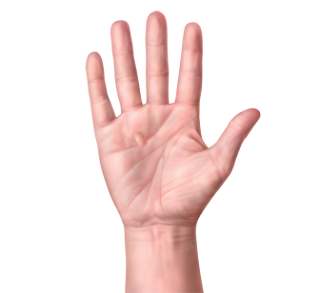
I swear I’m not on drugs right now, but have you ever thought about hands?

Our hands are what allow our brains to change the world. Aside from the occasional kick, shove, or kiss, everything we accomplish is accomplished with our hands. Way back, it started with tossing rocks to form sharper rocks. Smashing those rocks against trees gave us wood. With more tossing, smashing, and a few handshakes, we cooperated to build a house.

Iterate on those basic themes, add in some poking, pinching, flicking, grasping and gripping, and we end up with everything humans have ever built. Those wriggling flesh nubs in front of you have turned rocks and trees into everything from the Tesla factory (426,000 square meters) to the transistor gates on the computer chips that power those cars (14 nanometers).
 
We think of these things as being created with machines, but those machines were built by other machines, created by other machines, etc., until the only machine is, you guessed it, the ten bones wrapped in supple leather that are permanently attached to most of our upper limbs.


A hand.

These days, much of our communication happens with our hands, rather than our vocal cords. I’m wiggling my fingers in a fancy pattern here in Ontario, Canada, and you’re flicking at a slab of glass wherever you are, and somehow what’s in my brain is affecting what’s in your brain.
 
WE LAUNCHED PEOPLE TO THE GOD DAMN MOON USING ONLY THESE SCRATCHY SAUSAGES.
 
Whoa, where am I? Oh yeah, I forgot this is a writing blog, so let’s tie it back to writing. Arthur C. Clarke once wiggled his fingers to write that any sufficiently advanced technology is indistinguishable from magic. When the fingers of other writers engage in their own sort of telepathy with readers, perhaps it helps to keep in mind that no matter how strange the worlds they invent are, the real world is just as strange. A fantasy novel may have a complex magic system, but our own world has its own sort of magic. We can conjure factories and computer chips out of mere gestures.
 
Think about that next time you’re staring at your grabbers and daddles. 

Monday, November 1, 2021

The One Tool That Can Double Your Writing Output

P.T. Phronk
A post by P.T. Phronk,
of Forest City Pulp fame

Please forgive the clickbait headline and inevitably disappointing answer, but I have a point to make. So shut up.
 
I’ve discovered a device that can literally increase how many words you write if you use it enough. It’s something that’s commonly available, and you may already have one in your home.
 
The device that can double your writing output is: the bicycle.
 
An article has been making the rounds claiming that eating one hot dog subtracts 36 minutes from your life. While that’s likely oversimplified, it’s certainly true that people who engage in unhealthy activities like eating hot dogs, smoking, and sitting still all day die sooner than people who don’t. Who sits around all day? Writers. Yet, what is a basic requirement for typing words? Being alive.
 
When you’re on a bicycle, not only are you not sitting still, but you are burning off the calories from that hot dog you hurriedly shoved into your face so you could get back to writing.
 
Cycling on a regular basis adds years to your life. One article estimates an extra 5 years for people who cycle vigorously, though that estimate obviously depends on a lot of other things.
 
Perhaps more importantly, regular exercise gives you more years of productive life, free from effects of aging like dementia, physical pain, and dealing with disease. Even if you don’t live longer, you can be healthy longer, and that means more years of putting coherent words on a page. 


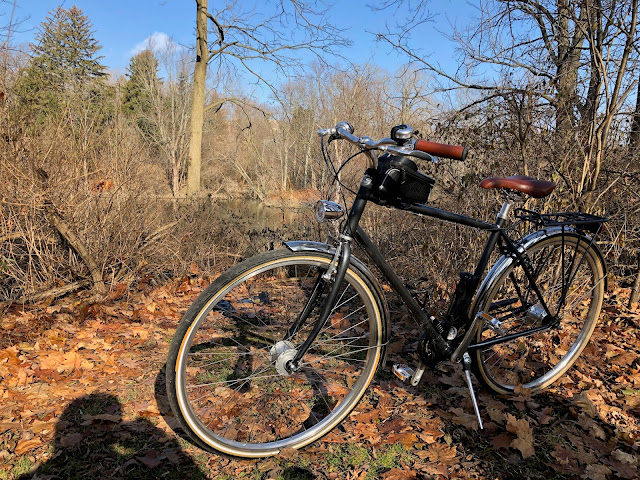
My bicycle. Getting on a bike and riding into the woods is the best thing you can do for your productivity. Optional: coming back.

Since I turned 40, I’ve been thinking about this a lot. I’m beginning to feel the effects of age, but I still have enough years ahead of me to fit in a lot of hot dogs—or bike rides. Habits I stick with now will affect how many things I can do each year, and how many years I have to do them. I’ve been using writing as an example, because it’s easy to quantify: 60 minutes of cycling a week can equate to an extra novel or two in my lifetime.
 
However, the less quantifiable and more immediate effects matter too. I feel great after a long bike ride, physically and mentally. Biking around for an hour or two is a rare chance to focus entirely on the present moment. Without the ability to check my phone or listen to a podcast or think about anything too complex, it’s like meditation, except the focus isn’t my breathing, but the path ahead. And if I must return to the capitalist habit of quantifying the benefits in terms of productivity: I’m way more inspired and motivated to make shit happen after I’ve had that chance to clear my mind.
 
It won't necessarily make me write better, so I'll probably just end up writing about zombies again, but at least I won't be one.

---
 
P.S. Autumn Christian wrote about some similar things in her newsletter recently. “I think we should bring back the weight lifting philosopher. The jacked intellectual. Lift weights in the morning. Write brilliant dissertations in the evening. Learn that everything we do is a circuit, a conjoined union, and we are our bodies as much as our brains.”


Monday, October 4, 2021

Back Jacket Hack Job: House of Leaves

P.T. Phronk
A post by P.T. Phronk,
of Forest City Pulp fame
It’s my turn to do a back jacket hack job, in which I emerge from my shack to whack at a back jacket to give it flack until it cracks.
 
I finally finished reading House of Leaves recently. As a novel, it’s very … challenging. You can read my review on Goodreads to see what I thought. The description on the cover could go something like this:


House of Leaves, by Mark Z. Danielewski


WARNING: do not open this book unless it appeared mysteriously on your doorstep in the rain. This isn’t a horror novel, it’s an experience. The book should be absolutely filthy, waterlogged, almost impossible to read. If you bought this in a book store, you are not getting the full meta experience. This is Mark speaking. Also: fuck you.1


What you are about to critically engage with is a story about a person discovering a transcription of an analysis of a movie about a house that’s a metaphor for a relationship. You lost already? For an explanatory prologue, please search your local pawn shop for the out-of-print references in Appendix D. I don’t want to see you read one page before you put in the work to understand the nuances of academic texts, have listened to the compact disc of my sister’s album, and are prepared to sit down and over-analyze every sentence of this 700-page manuscript.


As Natsume Sōseki remarked, after watching you read this back jacket from the impossible crawl space beneath your second-floor office: “Your addiction to thinking will come back to haunt you.”2


There is one final message to understand before you open this book and begin. As I write this, I’m on a rollercoaster that appeared in my bathroom (long story), so this important message is upside-down and backwards. Stand on your head and look in a mirror or something:


ɟnɔʞ ʎon


1 Psst, hey, it’s me, the guy who left the book on your doorstep. Don’t worry about that Mark guy. Nice lawn. It reminds me of this time I was in Shrewbury, woozy on shrooms and crushing hard on a stripper who was also an assassin who called herself Jiminy Cricket, and we lay in the grass, which was the shade of my mother’s jade necklace, so let me tell you about [sentence continues for nine pages]


 Hey, it’s the editor. There is no Appendix D. Fuck you.


2 Natsume Sōseki, Light and Darkness (1917, Putnam Publishing Group), as quoted by therandomvibez.com


Is this a real book? I don’t know, but I guarantee you’ll put down House of Leaves to descend into a dark rabbit hole of Googling it, then find yourself in another room three hours later swiping through historical documents on your phone with no recollection of what led you there. It will take you five years to get through this book. Anyway, as I was saying about my mother and strippers, [twenty pages written in wingding font]


Hey it’s me, P.T. Phronk. I’m done. I’ll be back in a month, when I reveal the one tool that can double your writing output. It’s not what you think, so you’ll have to return to ATB in a month to find out what it is. How’s that for a cliffhanger? #marketing

Monday, September 6, 2021

Google Search: Bing Edition: Why Does It Matter?

P.T. Phronk
A post by P.T. Phronk,
of Forest City Pulp fame
It’s my turn to do a Google search, which is when you do a Google search then write a blog post about it.

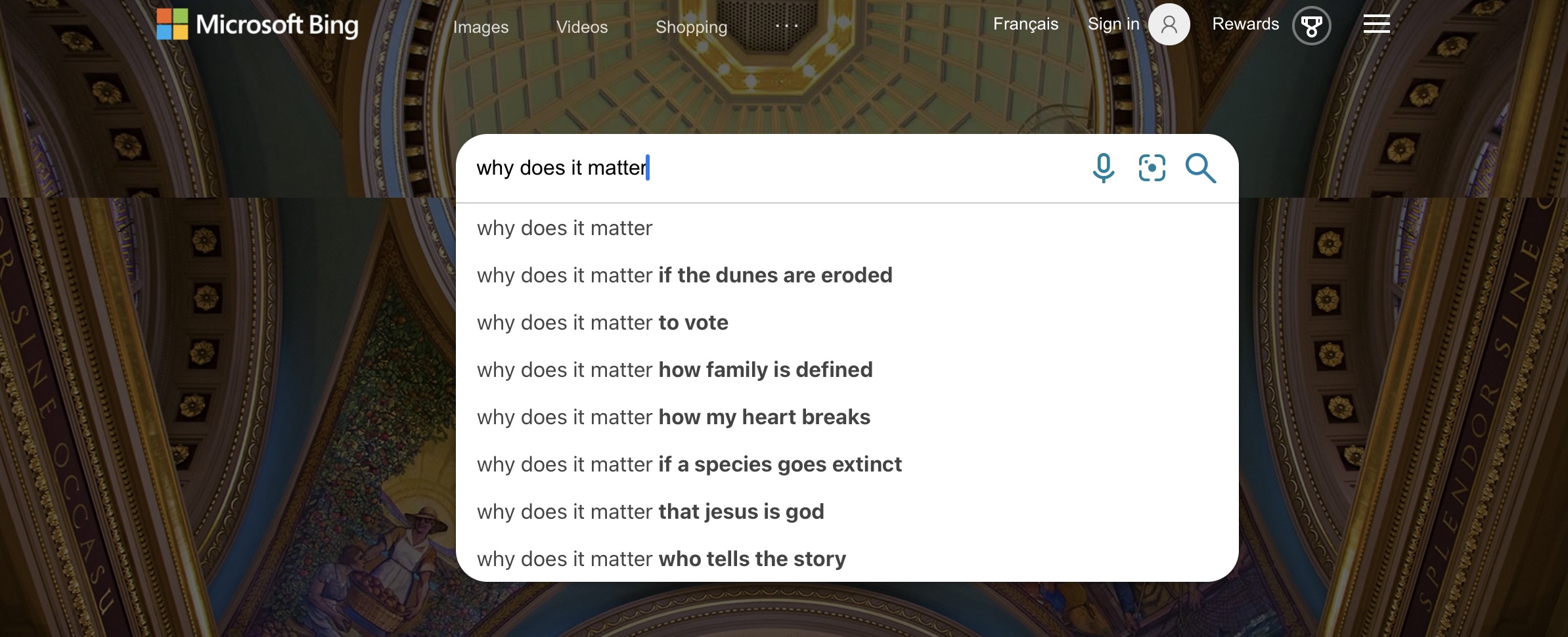
Sometimes scientists are not sure if a new finding is a universal truth or just a quirk of a particular culture, so they will conduct the same experiment in various countries and see if they get the same results. I wonder if we can do the same thing by looking at the auto-complete results of various search engines and seeing what commonalities crop up? Because those must be the most important concerns that people frantically type into search engines, and that all algorithms prioritize, whether you’re visiting good old Google, the much-maligned Bing, or the scrappy do-gooder DuckDuckGo. Maybe the comparison can help figure out what’s important and relatable, whether you’re doing a scientific study or research for your next novel.

Let’s start with the big questions. What matters, and why?


I see three things that come up repeatedly: religion, politics, and the environment.

Across all cultures (as defined, poorly, by search engine choice), the environment is right up there with life’s big, eternal questions. I think that says something. The end of the world has always been a topic of inquiry, but now it takes the form of specific questions about our planet, and perhaps they’re worrying questions, if it’s common to wonder why it even matters if forests, dunes, and entire species disappear.
 
I remember in 2003, a blackout hit us here in London Ontario, alongside much of the Northeastern chunk of North America. Apparently that was caused by a single tree touching a single power line in Ohio, which led to cascading errors across a complicated and fragile human-created system. If one falling tree can do that, think of what many burning trees, many floods, and many entire missing links in the food chain will do. The Internet is not a universal and eternal part of nature. It’s a breakable thing that one species cobbled together with its opposable thumbs, and that species may regret coming to rely on Google, Bing, and DuckDuckGo for answers to life’s big questions when the shit hits the fan, or the tree hits the power line.
 
Hey Google, how can I dig a well in my backyard? Google? Please, I’m thirsty.
 
We know this is coming, possibly in our lifetimes. Some of our leaders care about doing something to prevent what we can and prepare for what we can’t. Some leaders don’t. Another question that came up across search engines: “Why does it matter to vote?” Sometimes asking one question provides the answer to another.

Monday, August 9, 2021

Literally, Where Do You Get Your Ideas?

P.T. Phronk
A post by P.T. Phronk,
of Forest City Pulp fame
“Where do you get your ideas?”

That’s the infamous question writers get asked all the time, and many of them hate it. I think the hate is for two reasons: 1) I dunno man, I just make them up. The question forces writers to confront the fact that they don’t know themselves any better than they know a stranger asking the question; and 2) It implies that getting ideas is the hard part. Maybe a better question is: “how do work really hard to create a bundle of pages containing tens of thousands of words, wrapped in a professional cover with beautiful art and a snappy blurb, which people want to buy, that originated with a stupid thought that popped in your head while washing your junk in the shower?”


Which leads to another interesting question: literally where do you get your ideas? Like, what physical location?


This came up in a group for horror writers on Facebook recently, and answers included:


  • Lying in bed attempting to sleep.
  • At a boring day job.
  • On the couch watching a bad TV show.
  • While commuting, on foot, on a bicycle, or in a vehicle.
  • And yes, the shower.


There’s a common theme there: ideas flow when the writer’s mind isn’t blocked up with something else.


Perhaps that can help explain the first reason writers hate the non-literal version of that question. They can’t answer the question because the ideas only present themselves in certain physical locations where the mind can wander. Because of the “present themselves” part, this is where many discussions of this topic mention supernatural muses, or more realistically, the subconscious. Places that allow the subconscious to come out and play are fertile ground for ideas.


I think it’s more than that.


There is a component of ideas that does lie outside of consciousness, which is why the hated question can’t be answered accurately. However, there is also a component that requires consciousness. Lying in bed, routine tasks, showering—they don’t require conscious thought, so consciousness is free to interact with the subconscious. It’s not just letting the subconscious out to play, but having the capacity to play with it.


The subconscious isn’t a supernatural muse. It’s a child that craves attention, but only gets it from her workaholic parents when they can all take a little vacation together.


Knowing the physical location of ideas doesn’t help with the second reason writers hate that question, though—that it’s very hard work to turn ideas into something tangible—especially because almost all those situations make it hard to even jot down an approximation of the idea. I have a waterproof notebook in the shower, but I stopped getting ideas in that location as soon as I put the notebook there. The last “idea” I wrote down was this:


Letting the ideas flow.


Sometimes, that child only wants attention until she can actually get some, at which point she becomes … unruly.

 “Where do you get your ideas?” On the particularly dull stretch of sidewalk between Central and Queens on my way to work. In bed, while in the liminal state between waking and sleep. On the couch, watching FBoy Island, or doing nothing at all. I’m a writer; that counts as working.


P.S. I was scheduled to do an interview today, but I … did not. Apologies to the 5 people that know this blog has a schedule. I’ll try to be less antisocial next time


Monday, July 12, 2021

I Got Injected Where the Pigs Poop and It’s Filling Me With Hope for the Future

P.T. Phronk
A post by P.T. Phronk,
of Forest City Pulp fame
I got my second COVID vaccine yesterday, so this post might be a literal fever dream. Sorry.

It’s become almost cliché to say this, but do you ever snap back to reality and realize how weird things have become? Yesterday, I went to the place where my city’s annual fair is usually held. I passed the grounds where I’d normally be eating deep-fried-bacon-wrapped-Snickers then letting rickety carnival rides spin me around until I barf. I entered the “agriplex,” where I’d normally be watching chicks hatching from eggs, smelling pig shit, and letting scorpions crawl on me at the bug exhibit.

Except now, there hasn’t been a fair in two years because a deadly pandemic still makes gathering in large crowds a bad idea. No greasy foods, no rides, and the building that was previously full of chickens, pigs, and creepy-crawlies has been converted into a mass vaccination center.

In the exact place where I came face to face with the biggest horse I’d ever seen, a doctor injected a snippet of genetic material into my arm, where it will hijack my cells to create harmless replicas of a deadly virus, so that my other cells can recognize it and fight it if they ever come across the real thing. This is happening inside of me right now, and giving me a nasty headache, but it’s a good sort of hurt, like feeling pleasantly queasy after surviving a few flips through the air in a carnival ride. Totally worth it.

I hope the whirlwind of 2020 and 2021 will act like a vaccine for humanity. It seemed slow at the time, but I think history will show that 2 years is a pretty good pace for upending how we interact with each other and developing entirely new technology to inject into our arms and (hopefully) eliminate COVID as a worldwide threat. We learned that we are capable of fighting this one. Bigger threats are coming, as this summer’s extreme weather and wildfires are giving us a taste of, but with this vaccine swimming in my aching body, I have a bit more hope that humanity’s immune system will be able to face them.

Monday, June 14, 2021

All Stories are Horror Stories

P.T. Phronk
A post by P.T. Phronk,
of Forest City Pulp fame
I'm reading a book on writing: The Successful Novelist, by David Morrell, the guy who wrote First Blood and thus created Rambo. In it, he describes asking aspiring novelists "why do you want to be writers?" After getting the usual unobtainable goals out of the way (e.g., money and fame—yeah right!), he gets deeper into why writers write, and part of it is because we have terrifying ideas intruding on our thoughts that we need to get out.
 
"The difference between fiction writers and civilians," writes Morrell, "is that we make it our life’s work to put our daydreams and day-nightmares on paper."
 
He doesn't even mention the horror genre, but he describes how his process, and indeed the process for all writers, involves capturing vivid waking nightmares, each uniquely traumatic to a particular author.
 
No wonder writers don't like being asked where their ideas come from.


It's a thought that leads to an interesting conclusion: every great story is a horror store at its core. In order for a story to have the necessary conflict and personal meaning to make it a unique work from a unique voice, it needs to address a writer's greatest fears. Morrell even describes how the idea for his first short story came about while having a sudden waking vision of being stalked in a forest and feeling certain someone was going to kill him. Even when Morrell is not writing horror, his story ideas start with horror, and at their core are about overcoming fear and other types of trauma.

If every story is really a horror story, then what sets the actual horror genre apart? I suppose it's that, while all stories have some terrifying, hungry thing lurking below the surface, the horror genre lures that thing above the surface and lets it take a few nibbles. In the horror genre, fear is the point, not only a driving force.
 
I need to apply these lessons to my own writing. My writing has been stagnating, partly because of that pandemic thing, but I think also because I've been screwing around with stories that aren't deeply, intentionally personal, and if I'm going to take it to the next level, I need something more traumatic. The past year has uncovered a lot of fears in all of us, me included. Fear of isolation, fear of other people, fear of death, fear of losing people, fear of losing time, wasting the limited days we have on Earth pretending the universe is anything other than indifferent to the fleeting lives we spend chasing after little pieces of paper that we can trade for shelter and Starbucks. What a mess. I need to write some of this stuff down, and/or get therapy!
 
All writers in all genres, from action to romance to children's stories, should look for the horror underneath their stories. If there is no fear being addressed, some waking nightmare that the author and the reader can really identify with, then is the story's conflict compelling enough to drive the plot forward?
 
Maybe there are exceptions though. Let me know what you think. 
 

Monday, May 17, 2021

How Being a Writer Ruins Everything


P.T. Phronk
A post by P.T. Phronk,
of Forest City Pulp fame
It was Friday, I'd just finished work, and I had a whole weekend ahead with no plans. I laid down on the couch, and attempted to clear my mind. Finally, I could be free of the week's worries and just be, in the moment, no thought necessary.
 
Then I thought: is it "laid down on the couch," or should it have been "lay down on the couch"?
 
I subsequently thought: man, being a write ruins everything. I can't do anything without translating it into these stupid words. That would make a good blog post! That's when the phone came out and my notes app was open and I was no longer in a blissful state of care-free laying or lying or whatever.


Here are a few other things ruined by being a writer:


  • Thinking simple thoughts. It's never just "this sandwich tastes good." Instead, it's "how would I describe the taste of this sandwich, if I were to put it in a book, or tweet about it? Should I include details about how it smells? The feeling of incisors cleaving fresh bread? Ah shit, the sandwich is gone now." Do normal people even put their thoughts in words? Or do they just, like, taste things?

  • Watching TV. A plot twist is never just a plot twist for a writer. It's an opportunity to analyze what exactly led to the twist, what it says about the characters, how it fits into the overall structure of the story. Sometimes it's like I can't even let the intended emotions hit me, because they're wrapped up in analysis and logic, which ruins any good feels. I think I even miss literally seeing things. Sometimes my girlfriend will be like "haha that guy's hat is hilarious" and I didn't even know he had a hat because I was thinking about how that trope from three scenes ago is totally overused but I could totally do something different with it.

  • Engaging in normal relationships with humans. For a few different reasons. Being good at writing does not mean being good at talking, for one, so good luck getting a coherent string of words out of a writer's mouth unless they wrote it down beforehand. It's a beautiful thing when the writer's shell of introversion does manage to get cracked, though, because then they can mine the relationship for material. Some writers may keep a straight face, but deep down, a friend's heartfelt confessionary breakdown is being classified as "compelling dialogue."

tfw you finally have time for a relaxing vacation with the family.

  • Traveling. Oh cool, a new experience in an unfamiliar place? The writer must cram his head full of every detail and try to memorize what it feels like, because "write what you know" is awfully narrow when 99% of what you know is the beige walls of an apartment. Study up on that additional knowledge. It's not supposed to be fun.

  • Having biological functions. Writers don’t sleep, they just lie down and think about things that don't exist, then write those things down in a notebook beside the bed, repeat, and eventually pass out from the exhausting cycle. Writers don't poop, they just take breaks from their day jobs to do research and take notes in a private enclosed space. Even basic personal hygiene is a time for dreaming up ideas. Why do you think so many novels start with the main character looking in a mirror and end with them crying in a shower? 


There you have it, some slightly exaggerated reasons why writing ruins everything and you should never touch a keyboard. Am I even normal for a writer, or has something gone horribly wrong inside of me? Please let me know your perfectly-formed written thoughts. 

Monday, March 22, 2021

Google Search: Am I Normal?

P.T. Phronk
A post by P.T. Phronk,
of Forest City Pulp fame
We all search for a sense of identity. Some of us search by going on literal or metaphorical journeys of self-discovery, testing our limits to find out what makes us really tick. Others search Google.

It's my turn for a Google-search-based post here, so I thought I'd try to discover what Google knows about how people define themselves.

Searching "am I," here are the autocomplete suggestions:


It seems that most people are curious about their internal state, which makes sense. Even with the progress we've made in discovering more about the brain and mental health, human minds—even our own minds—are still full of mystery and confusion.

Then there are the people who suspect they are pregnant, and decide to hit up Google instead of a doctor or pregnancy test. When Google fails to tell them if they are pregnant, they try "am I pregnant quiz," and I'm not that kind of doctor, but I don't think a quiz can tell you that. Come to think of it, a quiz isn't the best way to tell you if you're depressed either.

A core part of identity is comparing yourself to everyone else. In my psychology work, trying to measure things like personality and intelligence, a consistent theme I see is that most people think they are different, but most people are not (and, mathematically, can't be). The normal curve is very normal, and so are most people. I'm sure you're just full of delightful quirks, but those are the exceptions to countless other measurable variables that you're smack dab in the middle on. A quiz can't tell you with certainty if you're depressed, but Google's auto-complete can tell you that you're not the only person trying to figure out if you're comparable to other people in how you think, who you're attracted to, or how you're feeling.

What else can Google tell us about being normal?


Ok, a lot of things about blood there. Yeah, we're all full of the stuff, sometimes it leaks out, and we all bleed the same colour. But aside from that, we are mostly searching to see if we are sadder or "crazier" than other people.

That got me thinking—is this a recent thing? 2020 was an unusual year for a lot of people. Let's look at Google Trends:


There you have it. Searches for "am I normal?" reached an all-time high in October of 2020.


It's normal to worry about being normal after a highly abnormal year.

Whether you're writing the inner workings of a character in a book, or just trying to figure yourself out, I think that it's important to remember that almost all people are struggling to figure themselves out, especially now.

Monday, February 22, 2021

I Forgot to Write For a Year

P.T. Phronk
A post by P.T. Phronk,
of Forest City Pulp fame
A writer friend of mine posted this article, noting that she'd felt like she was alone in her lack of creativity during COVID: Writer’s Blockdown: After a Year Inside, Novelists Are Struggling to Write. It made me realize I wasn't alone!

So I thought I’d pass this gift along to other writers: you are not alone if you haven’t been able to write well, or to write at all.


Before COVID, I dreamed about long stretches of staying inside, with endless excuses for cancelling plans to spend more time with my keyboard. Then my dream came true, and I just … didn’t. Other folks here on ATB have recently written about the art of doing nothing and tarot for writer's block, so it's not just me. I’ve already posted here about how, even early in the pandemic, I couldn’t find much motivation to write. It’s almost a year later, and I’ve mostly only written when I absolutely had to.


Now that the pandemic has gone on for an extended period of time, the reasons for the creative drought are becoming more clear. In addition to the fact that stress and depression are bad for creativity in general, the article above notes some practical blockers, like the difficulty of writing with kids and spouses around all the time, or the lack of inspiration from being in the outside world. Living life on a screen also makes it harder to spend even more time with a screen—perhaps writing by hand would help, if I remembered how.


Maybe the creativity is only dormant though. All the unusual experiences of the past year are building up in reservoirs in our brains, so when we finally have the motivation to write, we’ll have more empathy for people in a tough spot, more understanding of how a crisis plays out in the real world, more ideas for how things could have been worse—all excellent tools to make a story better. The world will open back up, and so will a fountain of creative juices. They’ll be everywhere. Creative juices spattered on every surface.


Uh, anyway. If you’ve had trouble writing, you’re not alone. That’s all I really wanted to say.

Monday, January 25, 2021

Back Jacket Hack Job: Books I’ve Never Heard of Edition

P.T. Phronk
A post by P.T. Phronk,
of Forest City Pulp fame

I’m scheduled for another back jacket hack job this week, in which I badly rewrite the summary of a book. 

What better way to butcher a book description than to write one for a novel I have not read, nor indeed, even heard of? Let’s take a look at Amazon’s bestseller list and pick a few books I am clueless about.


The Wrong Family: A Thriller, by Tarryn Fisher


Ah shit, sorry, this is super embarrassing. That family you ordered? We actually sent the wrong one.


It was a mixup in our computer system. The boys at the warehouse have had a real thriller of a day trying to get it fixed.


So if you don’t mind, could you place the family you received back in the box they arrived in, affix the return shipping label we sent you, and bring your family to the nearest post office?


Yes sir, yes, I know you’ve been enjoying this family. It’s our most expensive option. 


No, yes, I know, you received this family through no fault of your own. But I’m afraid you didn’t earn this family, and you’ll have to let them go. If you work hard and pull yourself up by the bootstraps, perhaps you’ll be able to afford a more luxurious family in the future. For now, we think you’ll find the Awkward Aunt and Uncle package satisfactory.


Thank you for your business, and apologies again for sending the wrong family.


The Guest List: A Novel, by Lucy Foley


In the thrilling sequel to The Venue Selection: A Novel, Lucy Foley brings us the next chapter in wedding planning adventure: The Guest List: A Novel. Finally having decided on getting married on what seems from the book cover to be an abandoned island, the bride must now choose which of her friends and family most deserve an inconvenient destination wedding.


It’s a novel!


The planning is about to begin, and the guest list could include anyone—including the bride.


Wait actually, yeah, the bride sort of has to be there. But who else? Should she invite her boss, or would that make things weird at work? Will her husband’s Aunt Agatha get in a fight with the bartender again? Wait, is Aunt Agatha even still alive?


Soon, the bride will make her choice. But there’s still one nagging question left: what font will she use on the invites?


Silent Ridge: A Gripping Crime Thriller and Mystery, by Gregg Olsen


The ridge has always been silent.


Once, he thought he heard it talk, but it was only one of those weird birds that sounds like it’s asking a question.


He would do anything to hear the ridge’s secrets. He would even do crime! Gripping, right?


In this gripping crime thriller that is also a mystery, you’ll find out just how noisy one ridge can be. Not noisy at all! It’s a silent ridge. Or is it? Maybe it is.


“This gripping crime thriller was the most mysterious one yet. If you want non-stop geographical-feature-based suspense, this is the book for you.”

—Agatha Olsen, Goodreads Aunt ⭐️⭐️⭐️


Like I said, I know nothing about these books, so, I’m mildly sorry if I stumbled on something offensive here. Bye now.

Monday, December 28, 2020

What Pretentious Scotch Reviews Taught Me About Writing

P.T. Phronk
A post by P.T. Phronk,
of Forest City Pulp fame
I have a few days off this holiday season, and that means I can get tipsy every night without having to worry about working with a hangover in the morning. My wonderful girlfriend also got me a bunch of scotch for Christmas, so that's been my drink of choice.

Have you ever read reviews for scotch? Google any random example and you'll see they're all pretentious as hell. Here are five egregious "tasting notes" about various drinks, from Whisky Shop Magazine:

“Absolutely filthy… like doing a bog swim without a snorkel.”
“The nose is a TNT banana, exploding bursts of fruit…”
“The hug of sherry is soporific”
“A pleasant dram, but lacks nerve and buoyancy.”
“Like putting Benny Lynch into the ring with Marciano.”


Ridiculous, right? I don't even know who those last people are.

Yet I find myself reading reviews for each scotch before I drink it. The more reasonable reviews may not mention TNT bananas, but they do include various fruits, spices, and inedible items like smoke and leather.


Wait ... meat?


And you know what? I enjoy the scotch more after reading these reviews.

Last night, after reading about Ardbeg's peaty nose and impression of a distant wildfire, I cleared my mind of the day's worries, watched the snow fall outside, took a sip, and was transported to a boggy landscape with a hint of smoke in the air. It was a nice experience. I could even compare it to a hug.

I don't know if that pleasant sip was a direct result of the chemicals in the scotch reacting with my tongue, nerves, and brain. I probably imagined half of what I thought I tasted. But it doesn't matter, does it? Taste is subjective anyway. If it can be enhanced by some pompous scotch blogger halfway around the world causing my brain to embellish a little, then I will continue reading flowery booze descriptions until I see the world through purple-coloured glasses.

Here's where I tie this back to writing. Writers sort of do the same thing as these scotch reviewers, except the embellishment is intentional, and we aren't constrained by the physical reality of liquid on the reader's tongue. If we're doing our jobs, we can make a person vividly hallucinate coastal air, a beach bonfire, and a soporific hug—no strong liquor necessary.

In a year when inspiration was badly needed, that's where I've most recently found mine. I hope you find yours too, and have a very happy new year!

 
Blogger Template by Designer Blogs