Thursday, September 23, 2021

Tedious Is Not My Forte


Tedious, tiresome or monotonous, deadly dull, and honestly, that is the life of a writer. 


Writing happens in fits and starts, in between, it’s all about editing out the crap, coming back from our self-induced distractions, and of course multiple trips to the refrigerator. Back and forth I walk from the office to kitchen, kitchen to office, office to kitchen not unlike the cursor that moves stoically across the page. 


I emulate the actions of my mind or is it my hands that emulate the actions of my body?


Most of the time I open the refrigerator, look around, finding nothing of interest, I close the door, and leave. Returning to my computer, I open the page, browse the unappealing verbiage, close the computer, and leave. I might need therapy? 


Why do we do it?


What is the impetuous for keeping that blasted cursor moving across the page? 


Maybe I have this deep-seated hunger to reveal a tiny slice of reality. I reach for the dusty curtains, coughing as I push back the material that blocks your view, for a moment I’m blinded by the light that floods the room. I’m trying to show you something, I keep looking for the right words to describe what I see but I have to fight to get outside of myself. Painstakingly I crawl closer and closer to the truth. Knees bleeding.


No wonder writers drink. 


I wrap my words in so much shit if I washed away most of it, the rawness of what is left would only scratch the surface of what is true. I never fully arrive. It’s agonizing, like rashes, they itch,  and I scratch them until they bleed but the paresthesia is never satisfied. You know what I mean?


Some days I delete everything I write. Not one word is worth repeating. I toss my notebook across the room, it’s as if I am rejecting myself, and I’m thrown back to elementary school where it was a daily fight to belong.


It’s part of the deal, it’s the burden we carry, gutted by depletion we struggle on. 


Then there are the good days when everything flows as if a gentle stream trickling through a secret garden. These are the stakes that keep everything in place. But I’m camping on private land, signs posted “No Trespassing,” and this is how I understand grace. It’s undeserved. 


Today I’m writing with the computer on my lap, still in bed, with a cup of lukewarm coffee at my side. I’m already late with this post, I wrote the words above yesterday, I was clearly in a mood. Today, I’m picking through the words as if a pizza with anchovies that I asked for on the side. I can’t figure out where I was going and why I ordered an entire pie for myself?


Details, land rights, pulled up stakes? What the hell. Yesterday I had a direction but clearly, I’ve misplaced the map and now I’m standing in the middle of a post and have no idea where it’s going. Shit.


I slip out of the warm covers, make the incredibly short trek to the kitchen, but this time I refuse to open the refrigerator, I have the contents memorized, and besides there is nothing there that will satisfy my craving. I need a different sort of propellant. 


I consider crawling back to my room just to be dramatic but I think better of it as the floors haven’t been mopped in a while.


Slipping into the still warm covers, I go back to the first line, which is usually where I stash my agenda and read it again, “Tedious, tiresome or monotonous, deadly dull, and honestly, that is the life of a writer.”


It’s just not my forte.


When I’m not writing for Across the Board, I’m Living in the Gap, drop by anytime. 


Monday, September 20, 2021

She's A Bad Seed

 A review of The First Day of Spring by Nancy Tucker


A good book will make you feel things. Good things, bad things—thrilled, angry, wistful, it doesn’t matter. The magic comes from realizing these fictional people and their fictional problems have wormed their way so deep into your psyche that you become invested in the end of their story. You need to know what happens, and when it does, you leave the story, among other things, immensely satisfied.

A great book evokes the kinds of feelings that wash over you at the end of the last line, that make you laugh out loud or cry. They linger. For hours, sometimes days, making it impossible to pick up anything else. Some people call this a book hangover. At the end of the last page of THE FIRST DAY OF SPRING, I didn’t feel hung over. I felt destroyed. I locked myself in my office and sat in my chair and cried. Days later, a small part of me still aches. Part of me hopes it never stops.


I hadn’t expected any of it. When I picked up The First Day of Spring and read the first couple of pages, I thought I was walking into something twisted. A thriller with a hook I hadn’t read before. I bought it immediately.

The book opens with the eight-year-old protagonist (Chrissie) strangling another child. Tucker writes, “Sweat made it slippy between our skins but I didn’t let go, pressed and pressed until my nails were white. It was easier than I thought it would be.” Already a disturbing image, as Chrissie goes on to describe the fizzy feeling in her stomach when she realizes the boy is dead, the tick-tick-tick sound in her head as her body counts down to when she’ll need to feel the fizzy feeling again, Tucker forces us to confront these two seemingly opposing images—a murderer and a child—and try to reconcile them. It’s disturbing, and you can’t help but agree with the adults—oblivious to the murder—who call her a bad seed. There’s something wrong with Chrissie, they say. She acts out. Bites and kicks and steals and manipulates. And it’s no wonder, because she comes from the alleys where the poorest, most pathetic people live. And as the investigation into what happened to the little boy causes ripples throughout Chrissie’s small community, she tromps, peacock-like, through her days, knowing she is the smartest person in the world because she—and she alone—knows who killed the boy.

In a second timeline, Chrissie is grown and goes by the name Julia. She has her own daughter, Molly, and every day is an exercise in extreme discipline. Julia regiments their days, down to the quarter hour, because she believes it is the only way to keep Molly safe. To properly care for her because, unlike the other mothers around her, Julia doesn’t believe she knows how to comfort Molly. Nothing comes naturally to her. And when Molly falls off a retaining wall and breaks her arm causing Julia’s social worker to insist on a in-person meeting, Julia is convinced the social worker is going to take Molly away. Before that can happen, though, Julia decides to take Molly back to where it all started.

As the story progresses, eight-year-old Chrissie’s behavior spirals. But for every rotten action, every snide remark to show you just how bad Chrissie is, we are also reminded of how young, how sad she is. She tells her best friend that the boy won’t be dead for very long. She knows, because every few months her dad dies and then comes back to life. It isn’t until later that she realizes he doesn’t die at all—he’s locked up for petty theft and public drunkenness.

We spend so long being both fascinated and repulsed by Chrissie’s behavior that when we begin to discover why she acts out—how she steals extra milk and biscuits at school because the only food in her house is a bag of sugar, how she kicks and bites and snarls at the girls whose clothes don’t always smell of piss and sweat—the shame, the pity, creeps up unexpectedly.

As an adult, Julia bares the albatross of her past, making no excuses, all for the sake of her daughter. The thought of losing her fills her with pain, but she can’t help but wonder if she deserves it.

At the heart of this book is a message about growing up poor, being so young and ignored and hungry (for food, for attention, for empathy) you don’t know how to express yourself until the feelings build so high and so tight you have no choice but to explode.

We all have Chrissies in our lives. This book reminds us that every dirty child, every bad seed, is deserving of our empathy. That sometimes, all that stands between a difficult child and ruin is a kind word. A moment of attention. The time is takes to listen and understand.


Thursday, September 16, 2021

I Wrote a Bedtime Story for Adults


Several years ago, I wrote a random funny poem and posted it on Facebook. I forgot about it for a few years until my best friend made me the Maid of Honor for her wedding, and I had to give a toast. I didn't want to go the cheesy, emotional route, so I decided to be funny instead. I decided to read the poem, and it was the talk of the night. Everyone laughed hysterically and complimented me afterwards. That was when I started toying with the idea of making it into a mock-children's book. 

Well, after months of working with illustrator, Stephanie "Ms. Stubby" Webb, I finally did it. 'The Littlest Cock', as it's so coyly titled, is the story of the smallest rooster on a farm. He is often boastful and thinks highly of himself, and the larger roosters decide they're going to teach him a lesson. They are surprised to find, however, that it's not the size of the cock in the fight, but how it performs in the dead of the night, and they are the ones taught a lesson instead!

It's not a particularly dirty story, as there is no inappropriate language other than innuendo, but it's probably not something you want to gift to your young children, lest you prepare for the inevitable call from the school about obsessive usage of the word "cock" in the classroom. 

I'm writing this article on September 8th, and right now, it's in the final stages of editing before I release it on Amazon's KDP Select. I ordered a proof to review, and then I'll have it officially published before the end of September. It may or may not be for sale by the time this article posts. I'm hoping to get a lot of reviews for this book, so keep an eye on Amazon and my website, www.jessicaeppley.com, to secure your copy when it's released.

And remember to stay weird.

Monday, September 13, 2021

The Return of the Con

Hey everyone! Mary here, and it'll be a quick one from me tonight because I have to pack... for a convention!!! After a year and a half of Zoom panels and virtual portals, in-person cons are finally back, and it is WEIRD.

I'm heading off to Gen Con in Indianapolis, a con I've been exhibiting at since 2015, and I have no idea what to expect. Will there be any attendees? Will those who come be in a book-buying mood? Or even just the mood to talk to a stranger about the stuff they've written? Will they be shopping, or did the 'rona recession take its toll?

At least this won't be my very first con back. That was AwesomeCon in DC, a few weeks back. I was so unprepared, I didn't even have any signage. Part of it was because I'd been so burned by all the cancellations of 2020 and the first half of 2021 that I didn't expect it to actually happen. About 2 days before I was supposed to drive down, I was like "oh, I should probably pack books or something." I had to relearn how to use my Square app, re-rehearse all my elevator pitches. I didn't have any new swag... I was just handing out whatever bookmarks or cards I had left over from cons past.

It went pretty well nonetheless... surprisingly well, actually. Sales-wise, I did pretty decently. And I had fun debuting my new cosplay, as Silk from the Spider-verse. Sadly, very few people recognized me (an annoying number of Spider-Men and Spider-Gwens looked at me like "who??"). Funnily enough, Silk's relatively unknown status is a bit of a running joke in the comics, so huzzah for getting into character?

Anyway, I figure as long as I have books and a way to take payment, I can improv the rest. At least with Gen Con, I have enough stuff left over from cons past to be in decent shape (the "Sci-Fi Gals" banner I use while exhibiting with Brave New Girls co-editor Paige Daniels didn't make sense for AwesomeCon, where I was solo... just one gal). And if no one shows up, or no one's in a book-buying mood... well, at least it's better than being locked down again.

Wish me luck.

Thursday, September 9, 2021

The Road is Long: inspiring interviews with your favorite authors

Good morning, readers! It’s a beautiful week in the Poconos. The summer heat has subsided, leaving us with sunny days and near autumnal temperatures. As much as I love a pumpkin spice latte, I am not ready for summer to be over because once it’s gone, we get a blip of fall, and then we’re faced with endless months of frigid days and bare trees. Hang on a little longer, August.  

I thought I would do something different with this month’s interview piece. Rather than do a straight author Q&A, I threw on my librarian hat to assemble a small collection of inspiring interviews with the most successful and dope writers working today. So hold onto your butts and get motivated.

First up is one of my favorite interviews with the most ‘money’ of screenwriters--Jon Favreau. Who would’ve guessed that the genius behind Swingers would also be the creative giant behind many Marvel movies and the Mandalorian? In this interview for the Writers Guild of America West, Favreau talks about his writing process and keeping the story in sight. My biggest takeaway from the interview: writing before your brain fully wakes up.  

Elizabeth Gilbert’s take on criticism has a special corner in my writing brain. In this 2014 blog post from her website, Gilbert answers a reader’s question on how to cope with both personal and professional criticism. Gilbert reveals that she “has been on the business end of some really majestic denigration over the years, too.” If that doesn’t make you feel better after a one-star Amazon review, I don’t know what will. My biggest takeaway from the interview is Gilbert’s famous retort: "If people don't like what I've written, they can go write their own f**king books." Damn straight. 

If you haven’t read this yet, get on it. The New York Times recently published an interview with S.A. Cosby, award-winning author of Razorblade Tears and Blacktop Wasteland. He impressed his now agent--Josh Getzler--when he sat on an author panel at a conference and responded to a woman in the audience who was waxing poetic about the antebellum South. Cosby is the kind of guy with whom you’d want to sidle up to in a bar and buy a drink. Also his wife is a mortician, and I have so many questions about that. My biggest takeaway is that Cosby got his start with small presses and short stories, and his success came over time. If you don’t have a subscription to NYT, save one of your free articles for this.  

Almost every writer I know has read Stephen King’s On Writing, but there are also his many interviews to mine for writing gold. One of my favorites is this piece he very recently did with Esquire Magazine where he discussed his new project Billy Summers. I particularly like this interview because he specifically discusses noir and it’s one-last-job sub-genre, not to mention the hard task of writing a book inside a book. For all of you who are tackling ambitious projects, definitely check out this interview. 

Lastly, this interview with Elmore Leonard. He is one of the most prolific and celebrated writers of our time. Leonard died in 2013, but he is best known for his westerns and crime fiction bestsellers such as Out of Sight and Get Shorty, as well as these nuggets of wisdom: “If it sounds like writing, I rewrite it," and "I try to leave out the parts that readers tend to skip.” Leonard is often regaled for his gritty and realistic dialogue, even being asked if he ever did time. If you’re a fan of his, or just want to appreciate his pragmatic approach to writing, check out this interview from 2006.

If you have a link to an author interview that brings you inspiration, post it in the comments.

Monday, September 6, 2021

Google Search: Bing Edition: Why Does It Matter?

P.T. Phronk
A post by P.T. Phronk,
of Forest City Pulp fame
It’s my turn to do a Google search, which is when you do a Google search then write a blog post about it.

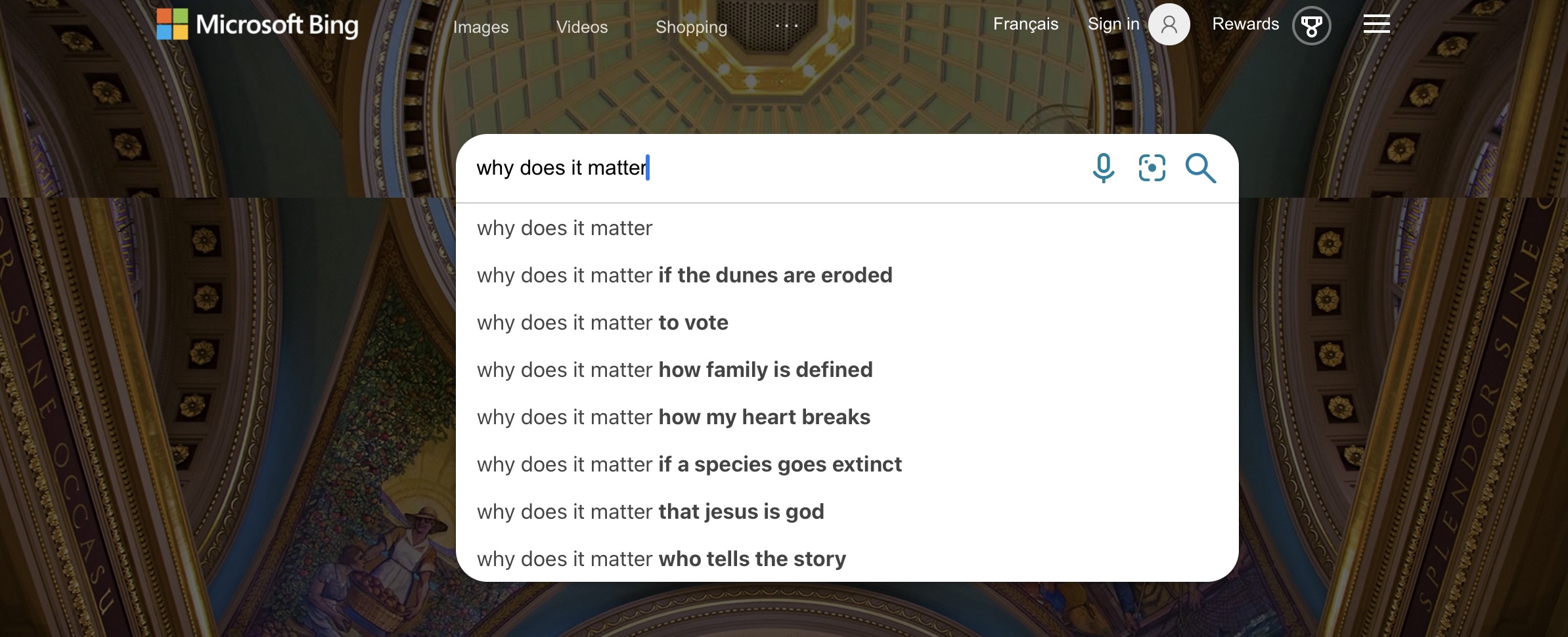
Sometimes scientists are not sure if a new finding is a universal truth or just a quirk of a particular culture, so they will conduct the same experiment in various countries and see if they get the same results. I wonder if we can do the same thing by looking at the auto-complete results of various search engines and seeing what commonalities crop up? Because those must be the most important concerns that people frantically type into search engines, and that all algorithms prioritize, whether you’re visiting good old Google, the much-maligned Bing, or the scrappy do-gooder DuckDuckGo. Maybe the comparison can help figure out what’s important and relatable, whether you’re doing a scientific study or research for your next novel.

Let’s start with the big questions. What matters, and why?


I see three things that come up repeatedly: religion, politics, and the environment.

Across all cultures (as defined, poorly, by search engine choice), the environment is right up there with life’s big, eternal questions. I think that says something. The end of the world has always been a topic of inquiry, but now it takes the form of specific questions about our planet, and perhaps they’re worrying questions, if it’s common to wonder why it even matters if forests, dunes, and entire species disappear.
 
I remember in 2003, a blackout hit us here in London Ontario, alongside much of the Northeastern chunk of North America. Apparently that was caused by a single tree touching a single power line in Ohio, which led to cascading errors across a complicated and fragile human-created system. If one falling tree can do that, think of what many burning trees, many floods, and many entire missing links in the food chain will do. The Internet is not a universal and eternal part of nature. It’s a breakable thing that one species cobbled together with its opposable thumbs, and that species may regret coming to rely on Google, Bing, and DuckDuckGo for answers to life’s big questions when the shit hits the fan, or the tree hits the power line.
 
Hey Google, how can I dig a well in my backyard? Google? Please, I’m thirsty.
 
We know this is coming, possibly in our lifetimes. Some of our leaders care about doing something to prevent what we can and prepare for what we can’t. Some leaders don’t. Another question that came up across search engines: “Why does it matter to vote?” Sometimes asking one question provides the answer to another.

Thursday, September 2, 2021

Back Jacket Hack Job: NOS4A2


www.karissalaurel.com
Hey everyone! Karissa here, and it's my turn to do a Back Jacket Hack Job! Basically, this is a recurring series where one of us rewrites a book's back jacket terribly. 

Since some people think the beginning of September is the beginning of "Spooky Season", and because I just finished reading/listening to NOS4A2, a horror novel by Joe Hill, I decided that would be a great back jacket to hack, especially since I kinda found the real blurb to be a bit misleading.


"If you love horror predicated on myogenetic bad guys and violence against women (especially mothers) and children, then check out this best seller horror novel that got converted to a cancelled TV series on AMC!"~Author , Karissa Laurel

"A book that feels a lot like, but not quite, a Stephen King novel, probably because it was written by Stephen King's son who was clearly influenced by his dad's bibliography." ~Reader, K. Laurel

Victoria McQueen, a deeply flawed woman who spends most of the novel in a state of perpetual denial has an uncanny knack for finding things using a Raleigh Tuff Burner bike and a magical covered bridge (this is a New England novel, obviously, even though Kate Mulgrew will narrate the audio version in a distinctly midwestern accent).  

The bridge eventually takes her to Charles Talent Manx, a soul sucking vampiric creature person who drives a really cool old Rolls Royce Wraith that's a lot like Kit from Knight Rider if Kit were possessed by a demon. You know, kind of like that evil 1958 Plymouth Fury in that one horror novel by that famous horror novel writer guy...I can't remember his name.  Anyway, Charlie Manx likes kids but not in that "kiddie fiddler" kind of way that everyone wrongly accuses him of, and he kidnaps and takes the kids to a perpetual childhood in "Christmasland" (Hint: Christmasland isn't as fun as it sounds). Helping him is the "Gasmask Man", a simple-minded, childlike man who really really hates women, especially "Mommies", and does everything he can to torture and abuse them throughout the book. Fun times.

Manx sees Victoria as a threat and tries to do bad things to her, but Victoria manages to escape and spends decades dealing, poorly, with the emotional trauma of her magical abilities and her near-death run-in with Manx and Gasmask Man. She has some good times, even manages to fall in love with a wonderful cinnamon roll of a man, and she writes some successful children's novels (that sound so cool they should exist in real life), but literal demons from her past haunt her into near insanity, and her life starts falling apart.

Eventually she and Manx and Gasmask Man have their final showdown when Manx, still pissed that Victoria got away from him all those years ago, comes to seek his revenge. She puts on her big girl panties long enough to get stabbed, burned, beaten, and broken a whole lot before she finally goes Grinch all over Manx's Christmasland.


Blogger Template by Designer Blogs