Showing posts with label editing. Show all posts

Thursday, January 21, 2021

An Interview with Emily Colin and Madeline Dyer, editors of UNBOUND--Stories of Transformation, Love and Monsters

www.karissalaurel.com
A few years ago I had the great fortune to be invited to contribute to a YA anthology called Wicked South: Secrets and Lies.  Emily Colin was one of the editors of that anthology, and I enjoyed working with her immensely. Luckily, she remembered me several years later and invited me to participate in her newest project, a YA anthology called Unbound, Stories of Transformation, Love, and Monsters, from Five Points Press.

I'm here today with New York Times bestselling author, Emily Colin and her SIBA Award Winning co-editor, Madeline Dyer, to get the details on this forthcoming anthology and find out more about their work on the book. Welcome Emily and Madeline!


When Emily approached me about the anthology, she said the stories should all be based on a theme of "transformation." But before she reached out, there had obviously been a lot of plotting and scheming going on behind the scenes. So, where did the idea to do a group anthology come from, and how did y'all settle on a theme?

 MD: I can’t specifically remember the occasion that we first thought of creating an anthology—it just seemed to be one of those ideas that had been bouncing around our group-chat for a little while—but it was during lockdown in 2020 when we really began to seriously think about it. The five of us in the group-chat (Emily, Lisa Amowitz, Sarah Anderson, Heidi Ayarbe, and I) thought that if we each wrote a novella/long short story, we’d have quite a good-sized anthology between us and also have all the skills we need to bring it to life, as while we’re all authors, between us we also have experience in all the other parts of publication—editing, cover design, interior art, marketing, etc. So, that’s where it started.

 And we settled on the theme of transformation pretty quickly really. We knew right away that we needed a theme that was flexible and could be adapted to a lot of different stories. That was really important as we didn’t want to be too prescriptive or controlling in what we were asking our writers to produce, and so themes that can be interpreted in many different ways (and across different genres too) are great.

Once we had the theme, we drew up a list of authors that we knew who we wanted to personally invite to submit work to our anthology before we put out general calls for submissions too.

EC: I feel like Madeline really said it all! I’ll add that the transformation theme also came from how challenging 2020 (and now, 2021) has been for all of us—that it’s changed every person I know in some ways, both big and small. We wanted to take that transformative energy and direct it into something creative. Our group has been a tremendous safe haven for us—even though between the five of us, we’re located in four different countries (the US, the UK, France, and Colombia), we chat multiple times every day—and we wanted to put some of that positive energy out into the world, during a time that we all need something to look forward to.

For me, there isn't a word better than "transformation" to exemplify the young adult experience, both in life and in literature. Young adulthood is literally the period of transformation between childhood and adulthood. There's so much change during that time, spawning so many experiences, and this anthology seems like a great expression of those various experiences. But having to choose just a few of those myriad stories seems like an overwhelming task! Can you tell me a little about what the process of putting together this anthology has been like from the Editors' point of view?

EC: Oh my gosh. It’s been fun, it’s been challenging, it’s been an adventure. We decided that out of the five of us, Lisa and Sarah would concentrate on design, Heidi would brainstorm marketing ideas, and Madeline and I—since we edit professionally—would take on that side of things. I’m in the US and Madeline’s in the UK, so sometimes coordinating stuff that we had to do in real time—such as having conversations with contributing authors—created a logistical quandary, but we figured it out!

Madeline talks a bit about how the details of the process worked, below, so I won’t go into that too much—but I will say that when you’re working with a diverse group of contributors, in terms of geography, background, styles, interests, experience, etc., it’s important to find a flow with each author. Madeline and I each worked with a select group of the contributors, but sometimes we’d collaborate to figure out the best approach for a given story. I loved this—editing can be a lonely process sometimes. It was lovely to have another editor to bounce ideas and thoughts off, and Madeline is brilliant. I felt spoiled!

MD: It’s been a lot of work! I definitely under-estimated how much work it would be. I write and edit full-time, and I thought at first that this would just be a nice, little side project! How wrong was I! Turns out co-editing an anthology is hard work and so, so time-consuming.

As stories came in, Emily and I read each one and voted on whether to include it (as well as getting Lisa, Heidi, and Sarah to vote too). We marked stories ‘yes’ or ‘no’ and began to think about how we’d work editorially on each story while also preserving individual voices and making the anthology into a cohesive whole. 

When we’d finalised which stories we wanted, Emily and I divided them between us, and we each worked with the authors on developmental, line, and copyedits. And of course Emily and I were each writing our own stories too—we were each other’s editors for those, so that was super fun.

How many stories will the anthology have and what kind of genres can readers expect to see?

MD: We’ve got 12 pieces in this YA anthology, including a thought-provoking contemporary story with an unreliable narrator, a beautifully poignant narrative poem, epic fantasy stories, and some dark and chilling speculative fiction. We’ve also got a number of #ownvoices stories in this collection too.

EC: Well, the anthology’s subtitle is Transformation, Love, and Monsters, so…I feel like that kind of says it all! One of the things I really adored about editing UNBOUND is that the theme ties all the stories together—but within that, there’s so much variety. As Madeline said, there are contemporary stories grounded in our reality, urban fantasy, dystopian fiction, love stories with a twist…the central theme is change, and that’s something that all of the characters in these stories do—for good or for ill! 

Among those 12 stories are the 3 that we've individually contributed as authors. I describe my story, "Of Marshmallows and Monsters", as a slightly fantastical, YA version of Pitbulls and Parolees--a girl seeks redemption for her gruesome past by rehabilitating monsters. Can you both give us a little hint of what your stories will be about?


MD: Sure! So, mine is called “Inside the Night,” and it’s a dark YA fantasy with a contemporary setting. It’s about a mysterious Power in the sky that turns people to stone, and it draws heavily on Greek mythology and the Medusa story, as well as taking a very feminist angle. It’s also #ownvoices for ace rep and chronic illness rep. 

EC: Oooh, yes! Mine is called “Smooth the Descent,” based on the quote, “Smooth the descent, easy is the way.” If you’re familiar with Virgil’s Aeneid, you might recognize that this references the descent into hell. ;) My short story is set in the universe of my YA trilogy, where people live—and die—by the laws of the Seven Deadly Sins. In it, a teenage librarian whose passionate curiosity far exceeds her restrictive society’s limits, and a medic whose desire to heal sends him in pursuit of forbidden knowledge, collide—and, despite the fact that lust is punishable by death, they fall in love. Hijinks ensue.

A little Easter egg—if you’ve read the first book or prequel novella in my Seven Sins series, you’ll recognize that the librarian and the medic in question are none other than my main character Ari’s parents. 

I've read both of the full-length novels in Emily's Seven Sins series (one of which is the soon-to-be-released sequel, Final Siege of the Seven Sins. It's awesome having connections and getting to read advanced copies!) and I'm super thrilled to get to read more set in that world. Along with introducing readers to your writing, what do you hope readers will get from this anthology?

MD: When I was editing the stories in this anthology, my favourite thing was the escapism it offered. These stories are all so different, and we’re covering many different genres while also examining the idea of transformation from so many different angles—the characters are engaging, the stories exciting, the plots surprising. One moment I’m on the moors of Scotland learning about folklore and monsters, the next I’m in an American museum where there’s a mummy on the loose. These stories really just grab you—and so I think (and hope) that escapism will be one of the big things that readers get. Especially in the current climate—escapism is what so many of us need.

EC: I couldn’t agree more! We created this anthology to give ourselves an escape from the crushing reality of recent events—and for me, at least, it delivered! I hope that readers will find that same sense of freedom in its pages—the sense of being transported to a world that exists alongside our own, where each story is a universe unto itself. 

Also, we were intentional, as Madeline mentions, about including a diverse group of authors. The writers in UNBOUND hail from Colombia, the UK, France, Cyprus, and the United States, and their stories represent their perspectives—including LGBTQIA+, chronic illness, and BIPOC representation. I hope that readers see themselves reflected in our characters, and find themselves spending time with kindred spirits as they read.

When, where, and how will the anthology be available to readers?

 Unbound releases on the 15th February, and it’ll be available as a free ebook download on Amazon and other ebook retailers. There will also be hard copies available to purchase from the usual sites and stores too.


Thank you so much for taking the time to talk to me about Unbound and give us a glimpse at the hard behind-the-scenes work the editors have to put into such an undertaking. I'm so proud to be a part of this project, and can't wait to share it with our readers. Find out more about Emily and Madeline here:

Emily Colin's debut novel, The Memory Thief, was a New York Times bestseller and a Target Emerging Authors Pick. She is also the author of The Dream Keeper’s Daughter (Ballantine Books). Her young adult titles include the anthology Wicked South: Secrets and Lies and the Seven Sins series, including the upcoming Shadows of the Seven Sins (June 2021) and Siege of the Seven Sins (August 2021), from Blue Crow Publishing.

Emily's diverse life experience includes organizing a Coney Island tattoo and piercing show, hauling fish at a dolphin research center, roaming New York City as an itinerant teenage violinist, helping launch two small publishing companies, and working to facilitate community engagement in the arts. Originally from Brooklyn, Emily lives in coastal North Carolina with her family. She loves chocolate, is addicted to tiramisu, and dislikes anything containing beans.

Emily is represented by Felicia Eth Literary. You can find her at www.emilycolin.com.

Madeline Dyer is a SIBA-award winning author. She lives on a farm in the southwest of England, where she hangs out with her Shetland ponies and writes dark and twisty young adult books. She is pursuing her MA in Creative Writing from Kingston University, having obtained a BA honors degree in English from the University of Exeter. Madeline has a strong love for anything dystopian or ghostly, and she can frequently be found exploring wild places. At least one notebook is known to follow her wherever she goes.

 Her books include the Untamed series, the Dangerous Ones series, and Captive: A Poetry Collection on OCD, Psychosis, and Brain Inflammation.

Madeline is represented by Erin Clyburn at the Jennifer De Chiara Literary Agency. You can find her at www.madelinedyer.co.uk.

Thursday, August 2, 2018

Nothing is a Horrible Word

By Cheryl Oreglia


When it's time to post a blog sometimes the panic surges up in my esophagus, as if struck by severe indigestion, and I find it hard to breathe. Especially if I am late to the process. Desperately scanning my life for relevant material, knocking back cup after cup of french roast, but when nothing surfaces, I slump against the wall in total resignation.

Nothing is a horrible word. It means of little importance, of no concern, not anything, nil, zero, zilch, nada, zip, diddly-squat, and apparently that's all I have.

In a feeble attempt to avoid the blank page I order a therapeutic candle and vintage mixing bowls from Amazon. The thrill is short lived.

These are my current thoughts, "I want to accost the gardner who has been running the blower since eight this morning, causing the neighbor's dog to bark incessantly, and the whine from the refrigerator is taunting me.

I might need to move to Paris?

With nothing to write I'm sort of forced to scan Facebook, but it's the same three friends, checking into the same three restaurants, eating the same enticing food, which they photograph and post. Now I'm hungry.

I open both sides of the refrigerator and narrow in on a slice of leftover steak. It's dry, someone has taken a bite out of it, and decided to leave it behind? Maybe I'll take a picture and post my pathetic meal on Facebook? Maybe not.

Continuing to veer off course, I send out a few self-serving tweets, watch the hummingbirds fight over the feeder just outside my window, when unexpectedly I become fixated on exfoliation.

Diligently digging through my makeup drawer for said product, I spend ten minutes massaging mud onto my freshly washed face. Glancing in the mirror at the dried brown mask I realize all I'm doing is hiding. Damn. I hate it when reality slaps me in the face.

Rinse. Moisturize. Pluck eyebrows because this seems less painful than plucking words from my brain.

Back to the blank page. Maybe I need is a prompt?

I rifle through recent events as if on the Easter egg hunt, searching for something hidden, relevant, apposite. It's daunting. The empty page stares me down until I run to the kitchen with my mug screaming, "the road to hell is paved with adverbs," a Stephen Kingism.

Sometimes I use starters like, "Today I notice... I'm curious about... I couldn't live without... I wonder about...." The word that keeps popping into my head is NOTHING.

Let's hope the coffee kicks in soon.

I admit during the summer it is especially difficult to write because I'm busy relaxing.

Now some people have interesting lives. I just don't happen to be one of them. But interesting things do happen around me.

When I started blogging I thought it would be effortless. Sit my ass  down in a chair and allow the words to flow through me. Ann Lamott says “All good writers write [terrible first drafts.] This is how they end up with good second drafts and terrific third drafts. . . I know some very great writers, writers you love who write beautifully and have made a great deal of money, and not one of them sits down routinely feeling wildly enthusiastic and confident. Not one of them writes elegant first drafts. All right, one of them does, but we do not like her very much. We do not think that she has a rich inner life or that God likes her or can even stand her. (Although when I mentioned this to my priest friend Tom, he said you can safely assume you've created God in your own image when it turns out that God hates all the same people you do.)”

Maybe I need  a priest?

Or a writing process?

What would a process look like? So glad you asked. Here, I gave it a go. You're welcome.

1. Feed the Blog. I need to get in the habit of jotting down memorable events. Worry less about spelling. Ramble, unload, let it go...this is not the blog, this is food for the blog (shitty first draft). For example, the enormous fires that surrounded us at the lake house last weekend, or the old friend who called me up out of the blue, because she's selling some miraculous anti-aging gel, and wants me to be part of her downline? Than there's my beloved cousin who demanded we clean out the refrigerator because she insisted a colony of botulism had moved in the produce drawer. The common theme seems to be preservation? We'll let those thoughts marinate while I cut up some cucumbers for my eyes.

2. Groom the Blog. I am a quote hoarder. It's true. I obsessively write down quotes, passages, articles, books that inspire. I keep a notebook handy or just record them verbally on my iPhone. This week I came across; "Be who you are and say what you feel, because those who mind don’t matter and those who matter don’t mind." Dr. Seuss. "Where’s your will to be weird?" Jim Morrison. "The most powerful weapon on earth is the human soul on fire," Ferdinand Foch. A Writer's Guide to Harnessing the Creative Power of Resistance by Deb Norton, "Don't look where you don't want to go." It's odd how I come across just what I need, just when I need it? Spooky... 

3. Weed the Blog. Spy on your thoughts suggests Deb Norton. Good writing is about telling the truth. Start with that shitty first draft, then weed, weed, weed until the truth is able to grow. “If something inside of you is real, we will probably find it interesting, and it will probably be universal. So you must risk placing real emotion at the center of your work. Write straight into the emotional center of things. Write toward vulnerability. Risk being unliked. Tell the truth as you understand it. If you’re a writer you have a moral obligation to do this. And it is a revolutionary act—truth is always subversive,” Anne Lamott. As if a child investigating a June bug, be fearless, notice everything, abandon yourself to the delight. 

4. Liberate the Blog. I'm not talking about the feminist movement, or burning your bra, this is about getting the words down and letting them go. “Perfectionism is the voice of the oppressor, the enemy of the people. It will keep you cramped and insane your whole life, and it is the main obstacle between you and a shitty first draft. I think perfectionism is based on the obsessive belief that if you run carefully enough, hitting each stepping-stone just right, you won’t have to die. The truth is that you will die anyway and that a lot of people who aren’t even looking at their feet are going to do a whole lot better than you, and have a lot more fun while they’re doing it.” Anne Lamott. I have this running inner dialogue which tries to derail me, I realize this comes from a place of fear, I attempt to mollify her with kindness, or caffeine, and then unfollow her as if an annoying Facebook troll.
“Who wants to become a writer? And why? Because it’s the answer to everything. … It’s the streaming reason for living. To note, to pin down, to build up, to create, to be astonished at nothing, to cherish the oddities, to let nothing go down the drain, to make something, to make a great flower out of life, even if it’s a cactus.” Enid Bagnold


What does your writing process involve? Where do you find inspiration? How do you generate material? I'd be ever so grateful if you shared a few thoughts in the comments.


Full story at Living in the Gap, drop by anytime, I crave good company.

Monday, December 5, 2016

Quality Control for Indie Authors


I’ve posted before about integrating my corporate skills into my writing. There was the two-part series I did on Presentation Skills, the post about establishing an author brand, and the one about the Law of Diminishing Returns. Being a self-published author is the same as running my own small business, and I love that I can pull from my past experience.

Today I’m back integrating my two worlds in one very exciting topic—quality control. As an Indie author, all accountability roads essentially lead to me. While I may contract out certain aspects of my business to others, it’s up to me to make sure it’s done right and keeps running smooth.

Here are the most important things you need to keep in your quality control zone.


Content
As I’m Queen of the Obvious, I like to start with, well, the obvious. It’s important to make sure what you write is checked for errors. Spend money on an editor. You want to make sure your work is as error-free as possible.


Marketing Materials
You’ve published your book (or are about to) and are ready to market the heck out of it. It’s important to ensure your marketing materials are error free. Get an extra pair (or two, or three, or more) of eyes on it to make sure you don’t miss anything. I messed up back with the publication of my first novel, Kingston’s Project. I had my graphic designer make me these awesome book cards. 


I approved them and had a box printed up. When they arrived I proudly presented one to my husband who said, “Cool, but there’s an error.” The word ‘planned’ was misspelled on the back of the card. I was mad at myself for not having him look over the concept before I had them printed and wasting money. (Luckily I was able to cut the cards in half—not what I wanted, but it kept me from wasting money.)

If you are creating a lot of your own marketing materials through sites such as Canva, make sure you have a quality check in place. Grammarly is great.


Author Website
This one is important as it’s likely the hub of your on-line presence as an author. Unfortunately, this one bit me in the butt just this past week. I usually visit my website, carriebeckort.com, several times a week. Last week, instead of seeing my landing page I was presented with ‘carriebeckort.com has expired’

WHAT?!?!?!?!

I had renewed my domain on time and processed the invoice. What in the ho-hay was going on?! Unfortunately, due to the Thanksgiving holiday, I wasn’t as on top of it as I usually am, so I’m guessing it was down for about 3 days. Luckily a quick live chat with my provider got it fixed and back up in minutes. Never assume your website is working the way it should. Check it out regularly.


Social Media Profiles
This one may not seem as obvious. Facebook, Twitter, Pinterest, Goodreads—they are managed well and if the site is down, then it’s not just you that’s affected. But that’s not the stuff I’m worried about. I’m actually checking my profiles. I want to make sure my information is up-to-date and my links are working properly. I’ve clicked on website links for authors from their social media profiles only to be directed to an inactive page. More than 90% of the time I don’t take the effort to find the correct site on my own. If the author doesn’t care to keep it accurate, maybe I shouldn’t care to find it.


Embedded Links
To expand a bit more on links, your quality checks should expand to include any link you provide. Blog posts, websites, newsletters—if you embed a link, go to the preview and make sure it actually works. Again, I’ve come across links provided and they don’t go to the targeted site and it’s frustrating.


Content
I know I already talked about this one up in my Mr. Obvious section. I didn’t forget to quality check my post for repeat points. I just want to hit this one again, in a less obvious way.

If you are publishing ebooks, make sure you check your formating on every device possible. I download to my Kindle and to my iPhone. I don’t own a Nook, but I have some close friends that do. I send them an early download version and ask them to do a quick review to make sure it all looks good. Here are two issues I’ve run into on my ebook formatting more than once:
  • Incorrect ‘starting point’—Shattered Angel was giving me a lot of fits with this. It would open up in the middle of my table of contents or in the middle of the first chapter. Since Shattered Angel starts at chapter 24 and counts down, it was critical for me to get the reader to the correct starting point so they weren’t confused (at least not any more than they already were). After a lot of hours reformatting and frustration, I finally got it to work.
  • Odd text formatting—When I check my ebooks, I actually do a fast skip through all the pages on my device. It might sound like overkill, but I thanked my OCD stars after discovering entire chapters in italics.


I use Createspace for my print books, and overall I’ve been pleased with their quality. Of course, the first step in print quality control is to order a proof book. I highly recommend this. I do check the on-line preview, but I also order a print book. The colors of the cover may not be as exact in print as it is online. Maybe that glossy finish you wanted doesn’t look quite right in reality. Maybe the cover dimensions were off a bit and the title is off center down the spine. You get the idea. It’s a few bucks and a few extra days, but it’s worth it.

Another thing I recommend is to spot check the print books you order intended for private sale and book signings. I might not have thought to do this, but before I published Kingston’s Project I read a book by a fellow author who printed through Createspace. Midway through the book I found this page:


I knew this had to be a mistake as it had nothing to do with the book. As a result, I decided to start checking the books I ordered. Basically, I just fan through the pages looking for anything that catches my eye. I haven’t found any errant pages, but I did find these errors on several books:

Books cut incorrectly
Ink blotches


Luckily, Createspace worked with me to replace the books.

I know quality control can be a lot of work. However, it’s difficult for many Indie authors to get visibility to new readers. There is also still a stigma out there that traditionally published books have better quality than Indie published books. As a result, every impression counts. Don’t sacrifice speed for quality. And if quality control is not your thing, then I suggest you find yourself a new OCD best friend!


~ Carrie

Monday, July 18, 2016

What’s a spelling-challenged Literary Engineer to do?


Have you ever seen this joke or a similar one?


If you’ve read any of my bios, you might recall that I’m a mechanical engineer by degree. While this joke is not accurate for many engineers (including my husband), I can tell you that it is accurate in my instance. I am horrible when it comes to spelling. Always have been, always will be.

And now I’m a self-proclaimed Literary Engineer.

Um . . . I think I have a problem.

Oh, wait—I’m an engineer. I can solve problems!

When I started to become serious about publishing my first book, I learned through my research that there are many readers who are passionate about an author’s ability to use proper grammar and spelling. That’s fair, after all. I can personally overlook a few errors in books (probably because I don’t notice them), but I have to admit to instances where an abundance of errors killed my enjoyment of the entire story. I knew I wouldn’t be in the camp of more errors than not for my own books, but I’m a big fan of eliminating distractions during the reading experience. I knew I had to pack my toolbox with some industrial grade spelling and grammar tools.

My aunt is a professional proofreader, so she does my final copy editing. It’s a huge relief to have a person I trust take a last crack at my books, but I still want to try to make the job a bit easier for her. I need to get better at catching my own mistakes. Because that’s the thing—in most cases I know what I’m supposed to write, but my fingers don’t always keep up with my brain. Except for spelling. When it comes to spelling, my brain is usually wrong.


I currently write almost everything in Word before I publish—be it a novel or a blog post—so the built-in spell checker is a huge help. However, it does not catch everything. For example, there are a few words I always seem to mix up, even though I know there is a difference and what that difference is.
  • quite and quiet
  • breath and breathe
  • choose and chose
  • heel and heal


These are just a few of the words always I seem to always mix up, so after I finish my manuscript I do a search for these words and correct any I have wrong.

Up next are the words that have multiple variations and different meanings depending on how you use them. For example:
  • someday and some day
  • awhile and a while
  • anyone and any one


Then there are words I didn’t have to use often in my job prior to writing, so I have difficulty remembering the rules. Sometimes I inherently know which to use, but I’ve never stopped to think about why. Writing novels has forced me to slow down and consider proper usage of words like:
  • farther vs further
  • burned vs burnt
  • blonde vs blond
  • were vs was


Most of the time I do a Google search of grammar sites when I need help, but there is one other tool I’ve come to depend on: Grammarly. You can install a plug-in for Word that will catch the errors spell check won’t, but I never was able to get that working properly on my end. But no worries, because I can copy and paste into my Grammarly account.

Most of all, I love that it installs (for FREE) on Chrome. This means I have a powerful tool checking my spelling and grammar for everything I do online: blog posts, comments, Facebook posts, Tweets, etc. There is a green circle in the bottom right-hand corner of text boxes which changes to red with the number of possible errors found.


This has saved my bacon many times! I want to look just as professional in my online endeavors as I do in my novels, but I can’t pay my aunt to proof everything I type (nor is it possible for her to do so). As a result, Grammarly has become a very important tool for me.

I realize perfection can’t be achieved, but I’m hoping these tools will correct enough of my errors to keep the grammar police off my back :) Just please don’t expect me to ever learn when to use whom rather than who. Seriously.

Feel free to share any tools or sites you’ve come to depend on in your writing—I’m always on the lookout for additional tools I can use! And, I highly recommend giving Grammarly a shot if you haven’t already.


~Carrie

Monday, May 2, 2016

Revisions Checklist


A post by Mary Fan
Writing is hard. There's a lot of advice out there about how to buckle down and just get that damn book written. Can't edit a blank page, first draft is supposed to be crappy, don't worry about it and just get it done, etc. etc. etc. Which is all true. But what do you do once you have your SFD (that's Shitty First Draft) banged out? How do you de-shittify it into something you can be proud of, something you can have confidence in? (Step one: remove made-up words like de-shittify).

This is where revisions come in. No one gets their book right on the first try, but it can be hard to see the way forward after emerging bleary-eyed from the Fog of First Drafts. So, to help you out a bit, I've created a handy dandy Revisions Checklist!

[✓] Make a list of things that are bugging you about your book


Sometimes, even as you're writing a book, you know there are things you're going to want to change later. Placeholder dialogue. Awkward transitions. Skeletal descriptions. I know an author who admits that her first drafts are little more than detailed outlines, and who goes back and fleshes out entire scenes, dialogues, descriptions, etc immediately after finishing Draft 1 (she's a pantser, so she's doing in her first draft what a lot of plotters do when outlining).

Sometimes, in the frenzy to just get that damn thing written, you'll cut corners. And that's perfectly fine! Just keep a list (or mark with comments) spots that you know you're going to want to fix up later.

If you didn't do this while writing (which is understandable, since it can break up your flow), then do it right after you finish the first draft. Give the whole thing a quick once-over and mark down which bits bug you.

[✓]  Incorporate the easy changes

Just a little trim here and there :-)
Sometimes, the things that bug you about your own book are relatively easy fixes, like "I don't like the dialogue between these two characters when they first meet" or "this action scene probably happens too quickly/easily." Sometimes, they're more complicated, like "I'm not sure if my villain's motivations make sense" or "I'm not sure if this sequence of events makes sense."

The things that bug you about your own book will be somewhere on a scale from "Oh, that's just a matter of find/replace, no problem" to "Dammit, that thing doesn't work and therefore this whole book needs to be rewritten!" Where any given problem falls on that scale can be measured in how many curse words spin through your head when you think about it (ranging from "*shrug* no need to curse, that one's easy" to your entire arsenal of F-bombs and assorted forms).

Go ahead and incorporate the little things, the quick fixes. But resist the temptation to start ripping your book apart at the seams to make the bigger edits right away. You're still in the First Draft Fog, so it can be hard to tell the good ideas from the bad, the changes that make sense from the changes that are just different. Write down your Big Picture Changes so you don't forget them, but don't worry about it just yet.

[✓]  Step away from the book
Let it goooooooo...
Different people have different reactions to having a Shiny New Manuscript in hand. Some are convinced the whole thing is perfect-perfect-perfect and others are sure that the whole thing is worthless and can't be saved. Most fall somewhere in the middle (or flicker between the two, depending on mood and caffeine intake). Those on either extreme are probably wrong.

In order to revise well, you need perspective, and the only thing that can give you perspective is time. Your manuscript is never going to be perfect, so at a certain point, just put the damn thing down and leave it alone for a spell.

[✓] Enlist beta readers

Hopefully, your beta reader will be as focused as this cat
One of the best ways to get yourself to stop futzing is to make it so that the manuscript is out of your hands. Plus, feedback is crucial to making a manuscript good. It's easy to get caught up in your own story, and what you write isn't always what gets read (something that might make perfect sense to you might confuse a reader who is Not You, or a dialogue you find funny might seem merely awkward to Other Person).

This is where beta readers come in! Beta readers don't have to be professional editors or anything... all you're looking for at this point is a fellow human being to read your book and give their gut reaction. So this could be your mom, your friend, your local critique group... anyone! If you don't already have a critique group or partner, or personal contacts willing to give your book a go, offer up a beta swap--you beta read my book, I'll beta read yours. Put the call out on social media or an author forum--you'll likely find plenty of fellow writers willing to trade perspective for perspective. Try to find a beta reader in your own genre if possible, since they'll have more of a sense of what you're going for. For instance, asking a women's fiction writer who has a hard time relating to speculative fiction to beta read your out-of-this-world science fantasy novel probably isn't a good idea. Neither is asking an epic adventure-loving science fantasy author to beta read a quiet, literary women's fiction novel.

Once the book is in your beta reader's (or readers') hands, DO NOT TOUCH. Resist the urge to change one thing, then email your beta going, "Actually, read this version. No wait... Fixed one thing. Use this version. No wait..."

It's hard to say how many beta readers is a good number. If you have a really great critique partner, maybe one is all you need. If you're a member of a local writers group, you could have literally dozens of eyes on your manuscript. In any case, it's not a numbers game.

If you have Big Picture things that are bugging you about your book, ask your betas to focus on those and see what they think.

[✓] Read over the comments, but don't incorporate them immediately

What receiving feedback can feel like
Receiving feedback can feel overwhelming, especially if you have numerous beta readers (not all of whom agree). And it can often feel like a huge wave of criticism-criticism-criticism burying you and your book into the crushing depths.

Here's the thing, though: Most readers only point out the stuff that bugs them. When they're reading stuff that works for them, they're into the story and don't notice the pages flipping. When something bugs them, they'll flag it and say "hey, you might want to fix this bit that doesn't make sense." So just because you see piles and piles of comments doesn't mean there's nothing good about the book. In fact, everything not commented on is probably just fine.

Read over the comments, but don't incorporate them right away. Because once again, you need perspective, and being on the receiving end of a barrage of comments will send you into Criticisms Shock (which is similar to the First Draft Fog, but not as fun). Your gut reaction will range from "YOU DON'T UNDERSTAND MY VISION, YOU FOOL!" to "Holy crap, you're right, and my book is completely unsalvageable!" You will likely go through the phases of grief... Denial (no, there's nothing wrong with my book!), Anger (how dare you say there's something wrong with my book!), Bargaining (but if I just explained it to you, you'd see it my way!), Depression (ugh, my book is awful and nothing can fix it), and then, finally, Acceptance (okay, you may have a point).


[✓] Consolidate the comments into a list

Depending on who your beta readers are, they might have a million suggestions for how to fix the issues they identified, or they might just say "this isn't working for me." Either way, only you can be the judge of the best way to incorporate their comments. Sometimes, the beta reader will be right to flag something, but their suggestion for how to fix it doesn't feel right. And then it's up to you to find a way that fixes the problem and works for your book.

Consolidate these comments--as well as the Big Picture items that were bugging you when you finished your first draft--into a list. This is the part where you decide what comments to take and what comments to disregard (Sometimes, if you fix one part of a manuscript, then a reader's comment on a later part won't be relevant. Or your betas will disagree, and it's up to you to decide which one, if either, to listen to). And this will help you keep track of all the stuff you want to do and see how the changes work in relation to each other (and make sure that one change doesn't contradict another).

Think of it as a To Do list for your manuscript.
Jotting down all those Things To Do

[✓] Start with the small stuff

Start by revising the things that are easy to fix--the nitpicky details your betas flagged (typos, small inconsistencies, etc). That'll help ease you into the revising groove. Jump around and get these things done first--and cross them off your list.
Just a few more trims...
[✓] Tackle the big picture stuff in chronological order

Now, you're ready to take on the heavy lifting. This is the part where you rearrange entire chapters, add or subtract characters, modify worldbuilding, etc. These Big Picture items are best done in chronological order, since what you change toward the beginning will probably affect the way a later scene turns out.

Keep in mind that sometimes, a comment that seems like it'll take a huge rewrite can be solved more easily than it seems (for instance, a few sentences of back story and/or internal dialogue can clear up a character's motivations, rather than you having to rewrite the entire character)

Mine that SFD for the gems!
[✓] Step away from the revised book

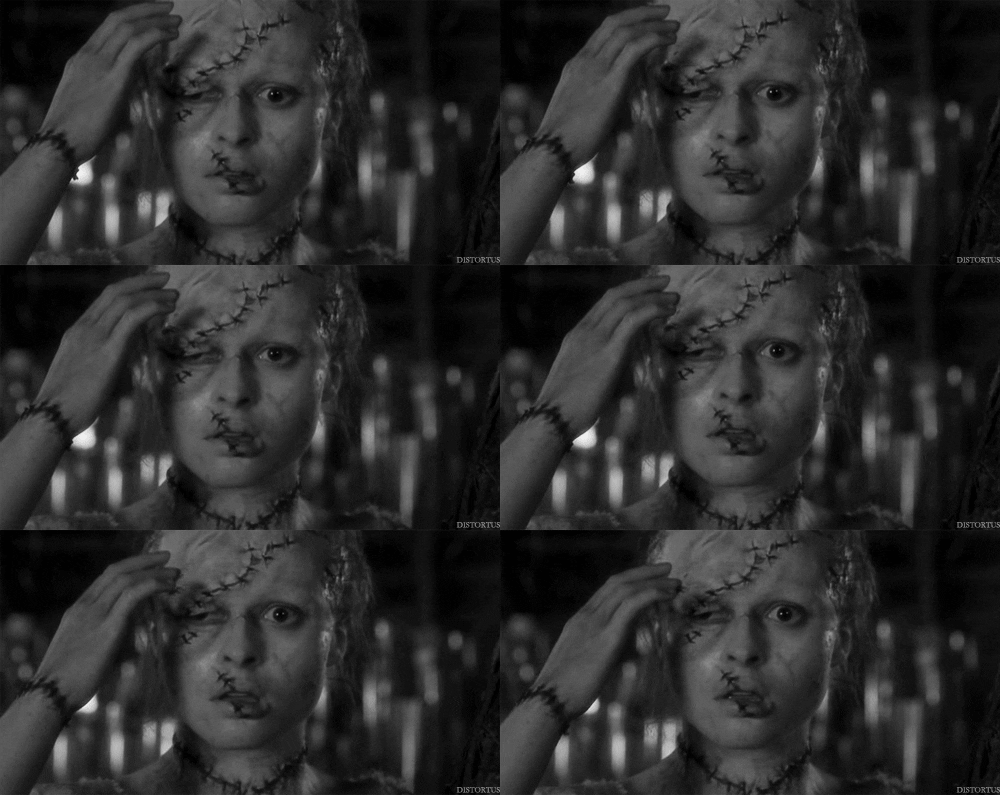
At this point, you have a whole new draft, which may feel like a whole new book that's worlds away from what you started with. And it probably feels a bit like you've got a Frankenbook on your hands--that is, a creature made up of bits and piece of other creatures that somehow developed a life of its own. All that chopping and sewing has probably put you in the Revisions Daze, which can be even more confusing than both the First Draft Fog and Criticisms Shock because you'll probably have bits of both lingering in your system in addition to this new stupor (rereading your own words can sometimes send you back into the First Draft Fog even after you've been away from the manuscript the first time, and Criticisms Shock can be triggered anew when you come across a particularly sticky issue you have to address).

So step away again. Give yourself a bit of time and distance from this new draft.

Hopefully your new draft will feel more like this...
...than like this

[✓] Read through the whole book

Come back and look at the new draft with fresh eyes. You'll probably notice a few vestiges from the old draft hanging out... a mention of a character you cut, a line of dialogue that mades no sense with the new scene, etc. Maybe a few nitpicky spots that could use some smoothing out. This is the part where you fix those little things, but otherwise, you're golden! For now, at least...

There's no way to tell when a book is DONE done (really, it never is). But at this point, if you've edited the book to your satisfaction and incorporated outsider feedback, you're probably well on your way.

May you feel this satisfied reading over your revised draft

 
Blogger Template by Designer Blogs