Showing posts with label revising. Show all posts

Thursday, July 18, 2019

Put on the headphones

Hellooooo all. It's been hella hot in the Poconos, and I am loving life. There is something to be said for when the heat pushes 95 degrees in the mountains. The freezing pool water actually feels refreshing for once. I do love a good thunderstorm when the evening rolls in and washes the humidity away.

So this is my children's last week of camp. Nothing like the eleventh hour to make a girl hustle. So what did I do? I set the ultimate deadline. Finish the goddamn revision this week before I head out to see Silversun Pickups in Stroudsburg. That's right. It's summer concert season, baby. And I intend to reward myself.

I canceled the gym this week. Put off an overdue haircut. I realize this sounds super bougie, but I was simply trying to reclaim hours for work. I probably (read: definitely) would get more stuff done if I just did the stuff in the first place and didn't fart around (as my mom would say). A lot of this is psychological. I am one of those terrible people who needs adequate conditions to write. Like quiet. And snacks. And certain cloud coverage and moon in retrograde. I kid. However, I am definitely the kind of person who procrastinates in order to avoid the drudgery of working out plot problems or trying to come up with another way to describe a character's mannerisms. Writing is work. It's fun in the beginning when the story is new and full of rainbows, but then it becomes work. Mundane, difficult work. And who enjoys that?

I envy authors (mostly men) who get to sit in a quiet spot and work uninterrupted. The only way I can do that is if I wake up at 5am (which I have done) or start writing at 9pm when the kids are in bed. And my brain is akin to oatmeal at night. I sometimes read forum posts where writers (again, mostly men) lock themselves in an office and work until it's finished. They announce to everyone that they did a marathon drafting session. The only way I've done that is by driving an hour away and spending money on a hotel. Either these writers don't have kids or they have a very awesome spouse who watches the children and keeps them out of the workzone. It's what I do when my husband teleworks. Cuz I'm awesome like that. Remember, behind every successful man is a great partner and behind every successful woman is her own insatiable ability to just get stuff done. Women are superheros.

But distraction-free writing isn't always an option. So I've compiled a list of tips and tricks to help you finish that draft. Even if you're working inside a rodeo. Here goes:

  1. Buy noise-canceling headphones.
  2. Listen to classical music. I use YouTube for this.
  3. Send your kids outside.
That's it. Three things. I'm serious.

I find I do most of my best brainstorming in the shower or when I'm driving--two very solitary activities. I work out the plot problem, scribble it down, and then put damn headphones on and two hours worth of Mozart, and I am working. It's dumb I know, but I'm tired of writing whiny blog posts about how hard it is to juggle life. I want the pay-off. I just gotta put on the headphones.

Wednesday, June 19, 2019

This is the book that never ends...

🎶🎶 This is the book that never ends, yes it goes on and on my friends. Some writer starter it, not knowing what it was, and she'll continue revising it forever just because...🎶🎶

Everyone!

🎶🎶 This is the book that never ends, yes it goes on and on my friends. Some writer starter it, not knowing what it was, and she'll continue revising it forever just because...🎶🎶

Welcome to June, folks. In my neck of the woods, the weather is wet and the kids are home. School has ended and I find myself STILL trying to edit a novel and also parent at the same time. It's a mixed bag of Hell if I'm gonna be honest. It doesn't help that there are no snacks in my house and I find myself tossing croutons at my kids to appease them. Here, eat this.

Until recently, I'd never truly been in the query trenches. I queried a novel in 2013. Sent if off to 25 agents and then hit small publishers where it got picked up. I queried another novel in 2016, sent it to five agents, where is got representation only to have had that agentship fall apart soon after. Now I'm firmly in the trenches where most days it feels like rats are feeding on my face while I sleep (WW1 reference) and it's (understatement of the year) difficult. Because while I am the deepest I've ever been in the process, I still feel so far away from my goal.

Agents are (rightfully) finding flaws with the book. Things that must be addressed. And this novel has been revised a trillion times already. I've gone from two points-of-view to one back to two, and then to four. Agents (who offered feedback) said the same thing: I didn't connect with one character's POV and the pacing needed work. Also, it was too long.

So I cut it down to one POV, making sure my antiheroine was the focus. But then I ran into issues with her motivation and character development. And one agent suggested I consider changing the verb tense.

You might think, well, this is your book. You're free to make changes where you see fit. And that is true. But what also is true is that you want your work to feel accessible. Everyone says that it only takes one yes to get an agent. One yes to get a publishing deal. But the more yeses I get from agents, the more yeses I'll get from editors. The more yeses I might get from readers. I want yeses. Otherwise all this work will feel in vain. At least, to me.

My friend recently took a Twitter poll to find out how long it took authors to write and revise a novel before it sold to a publisher. For most, two years+. I'm going on sixteen months. This book is a toddler.

Some days, it doesn't feel worth it. Some days, I think, just chuck it. Shelve it. Start anew. And when I take too long a break, I feel like my characters are haunting me. Peeking out from behind tree trunks to scold me. Get-r-done.

In the meantime, as I go back to my revisions, I'll sing my version of the Shari Lewis Lambchop song with the hopes that this will eventually end. Because there's another book ready to take its place.

Thursday, January 31, 2019

Notes on a revision

So this blog post is coming atcha late. I've been stuck in my house with my children for daaaaayz. Between random snow squalls and subzero temps, school has been canceled and I want to run screaming from my house. That's not an excuse for a fast blog draft, but maybe you can sympathize. Every time around this year, NEPA locals start planning their southern exodus. I can hear them now: We're moving to [insert southern state here].  It's tough, but we manage. Spring comes eventually. Or maybe it won't. Climate change and all.

I'm trying to revise a novel while also trying to keep my kids from killing each other. When I'm drafting, I welcome distraction because drafting is hard. But when I'm revising, I am hyper-focused and I hate to be interrupted. Because sometimes that perfect idea can slip away in the time it takes to peel a cheesestick for my kids who are starving for the 100th time that day.

One thing you should know about me is that I do not protect my work with any kind of preciousness. It is not "my baby." I am proud of my writing. I think I do my genre proud, but I don't get bent out of shape when I am critiqued. Especially before a book has been properly edited. Oftentimes, I am begging readers to be more harsh. I hate vague niceties. It's good. Blech. Tell me how bad it is. Then I can fix it.


However, I'm never quite sure what crits to apply and what to blow off. When a reader points out something that has been needling me in the back of my head, then I'm quick to make those adjustments. But when a reader points out things that I've never considered, the answer isn't quite as clear.

For example, a reader suggested I combine characters and remove another. That will certainly tighten the narrative, but will doing so also remove conflict that pushes the story along? My biggest fear is writing a boring book. Will inserting a new POV drag down the pace or ramp up the tension? Will taking out a blow to the protagonist make her job too easy or does it tighten the narrative? This is something that takes more time to consider. And, at this stage of having been working on this book for nearly a year, I'm not objective anymore. I just don't know.

So, perhaps, all this time indoors is a blessing. I need time to consider the effects of changes on an entire narrative arc. And that can't be rushed.

Thoughts? Ideas? Tips? I'll take anything.

Monday, December 10, 2018

The Tragedy of My Latest WIP

A post by Mary Fan
Hey everyone! Mary here, and I'm inadvertently continuing on fellow ATB blogger Kimberly G. Giarratano's theme on revisions. 

Once upon a time, I thought I had my writing process down. I’d start with oodles of brainstorms, then meticulously plot the story, then outline each chapter so that by the time I started writing, I’d have a pretty solid blueprint for what I was doing. Just add words. What emerged was usually pretty solid, and any revisions that needed to be made would be a relatively simple matter of condensing some parts, expanding others, and cleaning up.

In the past two years or so, I’ve been doing more pantsing—that is, writing without a specific plan and just seeing where the story goes. I’d still have something of an outline in my head, though—at least I’d know the major plot points and the shape/direction of the story. But perhaps more importantly, I had a solid sense of what the voice would be.

That’s where I thought I was with this latest WIP, which is a novel-length origins story for two characters I’d already written about in multiple short stories. This should be easy, I thought. I already knew the characters and the world, and all I needed was a plot. And so I hashed out a basic outline—the book was a mystery, so I figured all I needed was to map out who the suspects were and how the characters would discover the clues. The rest, I believed, would work itself out along the way.

I wound up writing the entire manuscript in about two and a half weeks total (I wrote the first four chapters of so in about three or four days, and then set it aside for a while to work on other things, then picked it up again and finished the rest in two weeks or so). Partly, it was because I had a deadline—I’d signed up for my local writer group’s full-novel critique session, and the date was coming up fast. And partly it was because I underestimated how many other things I’d have to work on at the same time as this book. I also got cocky. Having the characters, the world, and the mystery plot made me believe I was at that “just add words” stage.

Wellp, I was wrong. Writing in such a rush meant I purposely skipped over some parts. But it also meant that I didn’t think through others. Going into my critique session, I thought my revisions on the manuscript would be a simple matter of inserting the stuff I’d skipped over and expanding some parts.

My critique group gave me a lot of great feedback with regard to what was missing. But more notably, the remarked that the narrator’s voice and back story weren’t quite working. The book was supposed to be YA, but was coming across as more childish. Which was weird since I’d written this character before. But after reviewing the manuscript, I realized they were write. The voice was actually rather different from what I’d used for the short stories, and I’m not entirely sure how that happened. And her backstory, which I’d purposely left rather vague in the short stories, was flat, and that in turn made her rather flat. Maybe I didn’t know this character as well as I thought.

And so what was supposed to be a simple matter of “add more words” soon evolved into “rewrite the whole book.” Beyond reworking the voice and the back story, the entire beginning needed to be redone to better capture the mood of the world—and to actually have some kind of hook. And the middle section, which was super rushed before, needed to be redone to let the main character be more involved in the plot. I think part of the problem was because I had the suspects and clues all planned out, I just plopped them into the manuscript without actually giving the character a chance to discover anything. The ending might be okay, but all the revisions to the earlier parts of the book will probably have some downstream effects. Also, the voice.

Basically, I set out to write one book, accidentally wrote another because I was in a hurry (and got cocky), and now have to actually write the book I meant to. There are some parts that can be salvaged, and I do think it’s easier reworking a manuscript—even if it’s 90% of a manuscript—than starting completely from scratch. Still, suffice it to say that I’m not loving this situation. Especially since I’d planned to finish revisions by now, and I haven’t even started (though that’s mostly because I was feeling super burned out in November after two months of nonstop work on the two books I have coming out next year).

But even though my first draft ended up being an utter disaster and even more of a mess than most first drafts, I'm glad it at least exists. Sort of.

Have you ever had to redo your entire manuscript after writing it? What was it like?


Monday, May 2, 2016

Revisions Checklist


A post by Mary Fan
Writing is hard. There's a lot of advice out there about how to buckle down and just get that damn book written. Can't edit a blank page, first draft is supposed to be crappy, don't worry about it and just get it done, etc. etc. etc. Which is all true. But what do you do once you have your SFD (that's Shitty First Draft) banged out? How do you de-shittify it into something you can be proud of, something you can have confidence in? (Step one: remove made-up words like de-shittify).

This is where revisions come in. No one gets their book right on the first try, but it can be hard to see the way forward after emerging bleary-eyed from the Fog of First Drafts. So, to help you out a bit, I've created a handy dandy Revisions Checklist!

[✓] Make a list of things that are bugging you about your book


Sometimes, even as you're writing a book, you know there are things you're going to want to change later. Placeholder dialogue. Awkward transitions. Skeletal descriptions. I know an author who admits that her first drafts are little more than detailed outlines, and who goes back and fleshes out entire scenes, dialogues, descriptions, etc immediately after finishing Draft 1 (she's a pantser, so she's doing in her first draft what a lot of plotters do when outlining).

Sometimes, in the frenzy to just get that damn thing written, you'll cut corners. And that's perfectly fine! Just keep a list (or mark with comments) spots that you know you're going to want to fix up later.

If you didn't do this while writing (which is understandable, since it can break up your flow), then do it right after you finish the first draft. Give the whole thing a quick once-over and mark down which bits bug you.

[✓]  Incorporate the easy changes

Just a little trim here and there :-)
Sometimes, the things that bug you about your own book are relatively easy fixes, like "I don't like the dialogue between these two characters when they first meet" or "this action scene probably happens too quickly/easily." Sometimes, they're more complicated, like "I'm not sure if my villain's motivations make sense" or "I'm not sure if this sequence of events makes sense."

The things that bug you about your own book will be somewhere on a scale from "Oh, that's just a matter of find/replace, no problem" to "Dammit, that thing doesn't work and therefore this whole book needs to be rewritten!" Where any given problem falls on that scale can be measured in how many curse words spin through your head when you think about it (ranging from "*shrug* no need to curse, that one's easy" to your entire arsenal of F-bombs and assorted forms).

Go ahead and incorporate the little things, the quick fixes. But resist the temptation to start ripping your book apart at the seams to make the bigger edits right away. You're still in the First Draft Fog, so it can be hard to tell the good ideas from the bad, the changes that make sense from the changes that are just different. Write down your Big Picture Changes so you don't forget them, but don't worry about it just yet.

[✓]  Step away from the book
Let it goooooooo...
Different people have different reactions to having a Shiny New Manuscript in hand. Some are convinced the whole thing is perfect-perfect-perfect and others are sure that the whole thing is worthless and can't be saved. Most fall somewhere in the middle (or flicker between the two, depending on mood and caffeine intake). Those on either extreme are probably wrong.

In order to revise well, you need perspective, and the only thing that can give you perspective is time. Your manuscript is never going to be perfect, so at a certain point, just put the damn thing down and leave it alone for a spell.

[✓] Enlist beta readers

Hopefully, your beta reader will be as focused as this cat
One of the best ways to get yourself to stop futzing is to make it so that the manuscript is out of your hands. Plus, feedback is crucial to making a manuscript good. It's easy to get caught up in your own story, and what you write isn't always what gets read (something that might make perfect sense to you might confuse a reader who is Not You, or a dialogue you find funny might seem merely awkward to Other Person).

This is where beta readers come in! Beta readers don't have to be professional editors or anything... all you're looking for at this point is a fellow human being to read your book and give their gut reaction. So this could be your mom, your friend, your local critique group... anyone! If you don't already have a critique group or partner, or personal contacts willing to give your book a go, offer up a beta swap--you beta read my book, I'll beta read yours. Put the call out on social media or an author forum--you'll likely find plenty of fellow writers willing to trade perspective for perspective. Try to find a beta reader in your own genre if possible, since they'll have more of a sense of what you're going for. For instance, asking a women's fiction writer who has a hard time relating to speculative fiction to beta read your out-of-this-world science fantasy novel probably isn't a good idea. Neither is asking an epic adventure-loving science fantasy author to beta read a quiet, literary women's fiction novel.

Once the book is in your beta reader's (or readers') hands, DO NOT TOUCH. Resist the urge to change one thing, then email your beta going, "Actually, read this version. No wait... Fixed one thing. Use this version. No wait..."

It's hard to say how many beta readers is a good number. If you have a really great critique partner, maybe one is all you need. If you're a member of a local writers group, you could have literally dozens of eyes on your manuscript. In any case, it's not a numbers game.

If you have Big Picture things that are bugging you about your book, ask your betas to focus on those and see what they think.

[✓] Read over the comments, but don't incorporate them immediately

What receiving feedback can feel like
Receiving feedback can feel overwhelming, especially if you have numerous beta readers (not all of whom agree). And it can often feel like a huge wave of criticism-criticism-criticism burying you and your book into the crushing depths.

Here's the thing, though: Most readers only point out the stuff that bugs them. When they're reading stuff that works for them, they're into the story and don't notice the pages flipping. When something bugs them, they'll flag it and say "hey, you might want to fix this bit that doesn't make sense." So just because you see piles and piles of comments doesn't mean there's nothing good about the book. In fact, everything not commented on is probably just fine.

Read over the comments, but don't incorporate them right away. Because once again, you need perspective, and being on the receiving end of a barrage of comments will send you into Criticisms Shock (which is similar to the First Draft Fog, but not as fun). Your gut reaction will range from "YOU DON'T UNDERSTAND MY VISION, YOU FOOL!" to "Holy crap, you're right, and my book is completely unsalvageable!" You will likely go through the phases of grief... Denial (no, there's nothing wrong with my book!), Anger (how dare you say there's something wrong with my book!), Bargaining (but if I just explained it to you, you'd see it my way!), Depression (ugh, my book is awful and nothing can fix it), and then, finally, Acceptance (okay, you may have a point).


[✓] Consolidate the comments into a list

Depending on who your beta readers are, they might have a million suggestions for how to fix the issues they identified, or they might just say "this isn't working for me." Either way, only you can be the judge of the best way to incorporate their comments. Sometimes, the beta reader will be right to flag something, but their suggestion for how to fix it doesn't feel right. And then it's up to you to find a way that fixes the problem and works for your book.

Consolidate these comments--as well as the Big Picture items that were bugging you when you finished your first draft--into a list. This is the part where you decide what comments to take and what comments to disregard (Sometimes, if you fix one part of a manuscript, then a reader's comment on a later part won't be relevant. Or your betas will disagree, and it's up to you to decide which one, if either, to listen to). And this will help you keep track of all the stuff you want to do and see how the changes work in relation to each other (and make sure that one change doesn't contradict another).

Think of it as a To Do list for your manuscript.

Jotting down all those Things To Do

[✓] Start with the small stuff

Start by revising the things that are easy to fix--the nitpicky details your betas flagged (typos, small inconsistencies, etc). That'll help ease you into the revising groove. Jump around and get these things done first--and cross them off your list.
Just a few more trims...
[✓] Tackle the big picture stuff in chronological order

Now, you're ready to take on the heavy lifting. This is the part where you rearrange entire chapters, add or subtract characters, modify worldbuilding, etc. These Big Picture items are best done in chronological order, since what you change toward the beginning will probably affect the way a later scene turns out.

Keep in mind that sometimes, a comment that seems like it'll take a huge rewrite can be solved more easily than it seems (for instance, a few sentences of back story and/or internal dialogue can clear up a character's motivations, rather than you having to rewrite the entire character)
Mine that SFD for the gems!
[✓] Step away from the revised book

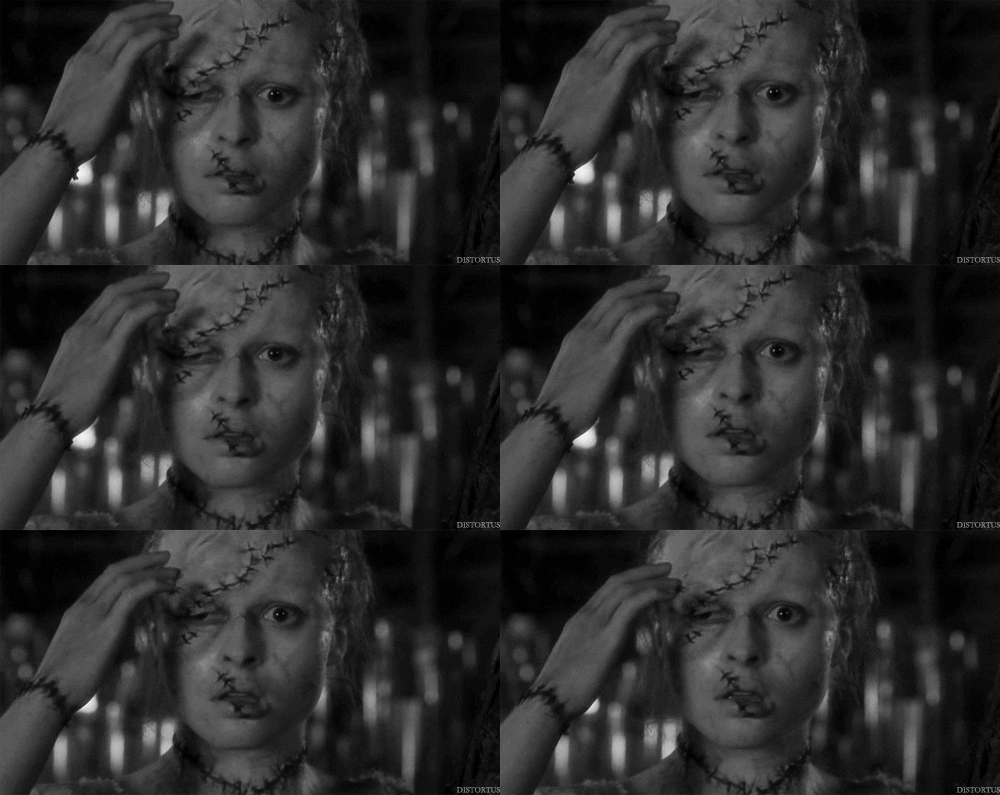
At this point, you have a whole new draft, which may feel like a whole new book that's worlds away from what you started with. And it probably feels a bit like you've got a Frankenbook on your hands--that is, a creature made up of bits and piece of other creatures that somehow developed a life of its own. All that chopping and sewing has probably put you in the Revisions Daze, which can be even more confusing than both the First Draft Fog and Criticisms Shock because you'll probably have bits of both lingering in your system in addition to this new stupor (rereading your own words can sometimes send you back into the First Draft Fog even after you've been away from the manuscript the first time, and Criticisms Shock can be triggered anew when you come across a particularly sticky issue you have to address).

So step away again. Give yourself a bit of time and distance from this new draft.

Hopefully your new draft will feel more like this...
...than like this

[✓] Read through the whole book

Come back and look at the new draft with fresh eyes. You'll probably notice a few vestiges from the old draft hanging out... a mention of a character you cut, a line of dialogue that mades no sense with the new scene, etc. Maybe a few nitpicky spots that could use some smoothing out. This is the part where you fix those little things, but otherwise, you're golden! For now, at least...

There's no way to tell when a book is DONE done (really, it never is). But at this point, if you've edited the book to your satisfaction and incorporated outsider feedback, you're probably well on your way.

May you feel this satisfied reading over your revised draft

Thursday, May 21, 2015

Accepting Your Desperation and Enjoying Coffee


I'm going to step out of my resident reader role for a moment to tell you about what I thought was going to be my own personal hell. Trust me, it has something to do with both reading and writing. I recently had a lengthy visit with my integrative practitioner to talk about dietary and lifestyle choices that could have an impact on autoimmune stuff happening within my body. We decided it was time to try an elimination diet for three weeks- no corn, soy, gluten, or dairy. Some of that wasn't so bad. After all, we switched to a mostly paleo (think caveman) diet in March 2014. However, I still had a firm grasp on my beloved French vanilla coffee creamer, which is obviously dairy. Because coffee is necessary to my life. In fact, I have a Pinterest board dedicated to it (found here) and another for fun mugs I'd love to use with said coffee (found here). Imagine my horror when I realized this elimination diet would seize that creamer from my fist and strip it away. I mean, really. I need it to function. 

My first thought was to quit coffee altogether. I'm serious. How was I to drink it without dairy? I'd previously tried almond creamer and couldn't do it. Well, with the help of many Facebook friends who took pity on my new predicament, I tried a few different things, all involving organic vanilla coconut milk (not coconut creamer, which contains carrageenan). Cinnamon and vanilla extract with the coconut milk was disgusting. Excuse me while I scratch the memory from my tongue. Maple syrup with coconut milk was better, but still nothing like my beloved creamer. Then I tried organic, non-GMO pure cane sugar with the coconut milk. Well, a few things happened. First, I was able to finish my cup of coffee for the first time in days. Second, I realized there's a fine line between the shade of coffee and not being able to taste the coconut; darker is better. And third, I was desperate enough to enjoy it. 

Of course I had to post about this newfound glory on Facebook, to which a friend commented that it was impossible to enjoy dairy-free coffee. So, if you ever find yourself in a similar situation and you need to find a way to accept your desperation, I've outlined a few simple steps. I'm sure this translates easily to other things, so feel free to apply it elsewhere. 

First, become desperate. That's key. Second, realize your options: make dairy-free work or go without coffee. This should inspire some crazy images to pass before your eyes of what life without coffee would be like, thus making the dairy-free option clear. Third, go light on the vanilla coconut milk and add a bit of non-GMO pure cane sugar. Fourth, drink and appreciate the fact that you still have coffee in your life.

How does this apply to reading and writing, you ask? Well, considering my focus is no longer tied up in mourning my loss--and the fact that coffee and I are friends again--I'm able to enjoy the reading I do with my morning coffee and I have this strong urge to continue in the drawn-out process of revising my MS (by the way, I'm now accepting applications for a long-term CP). I even found a few writing groups in my area. I'm able to function and actually get stuff done because coffee equals productivity in my life. 

Have you accepted desperation anywhere in your life recently? How did that work out? I'm also curious to know how you take your coffee. 


--Brianna Lebrecht 
 
Blogger Template by Designer Blogs